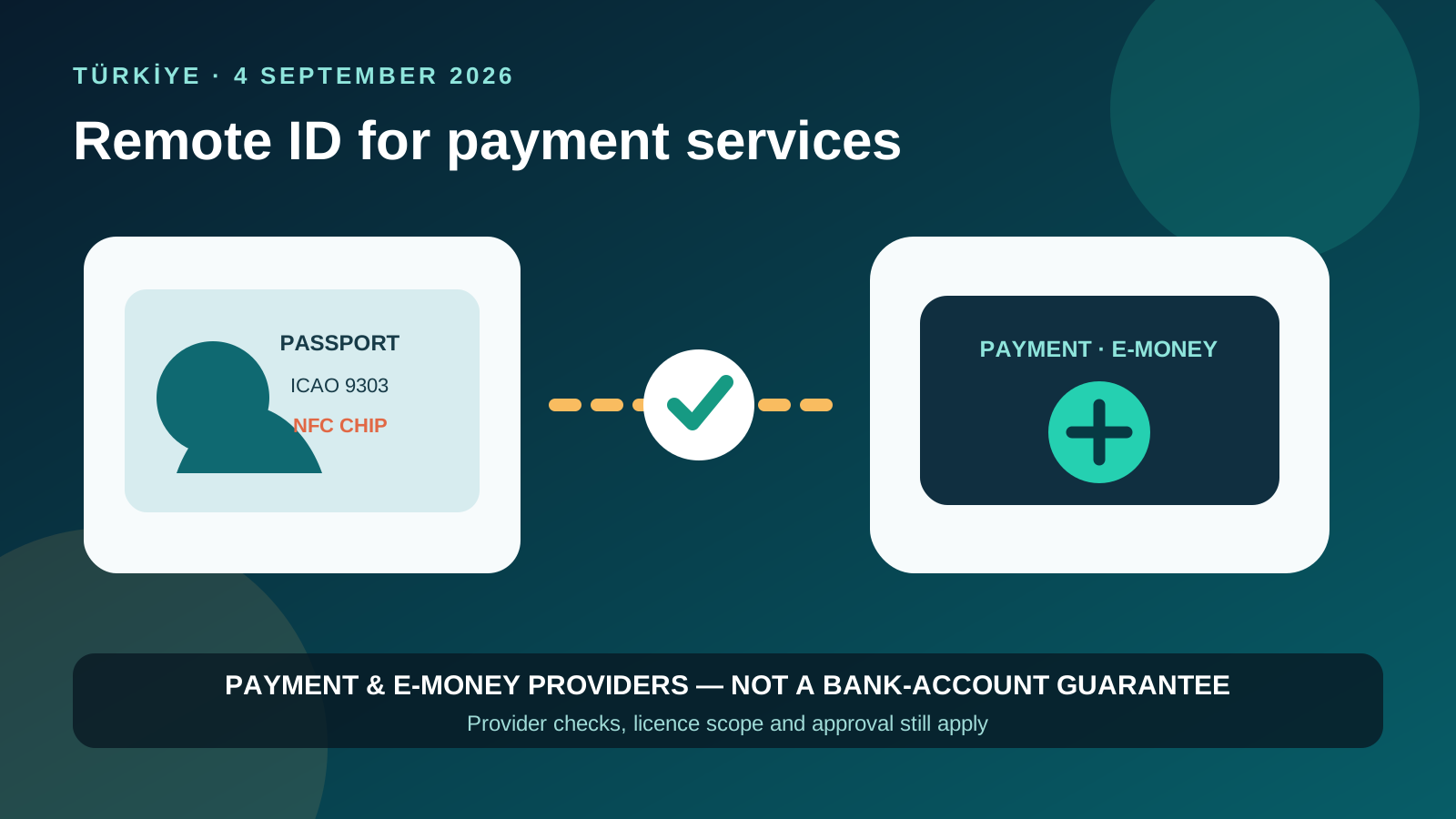
A Central Bank of the Republic of Turkey communiqué effective on 4 September 2026 expressly allows non-Turkish individuals to be identified remotely by payment-service and electronic-money providers. The route requires a passport compliant with ICAO Document 9303 and capable of near-field communication. For foreigners who use Turkish wallets, payment apps or money-transfer services, it may remove an in-person identity step. It is not a blanket right to open a Turkish bank account online, and each provider must still apply its own compliance and risk controls.
What the communiqué changes
The information-systems and data-sharing communiqué now contains a dedicated rule for foreign individuals. It says their identity may be established remotely under the relevant MASAK framework by using an ICAO 9303 passport with NFC. The provision entered into force on publication. Before this addition, the text focused mainly on the Turkish identity-card process; the amendment gives providers an explicit passport-based route for non-Turkish customers.
Which services fall within the scope
The rule concerns payment-service providers and electronic-money institutions governed by Turkey's payment-services framework. Typical activities can include digital wallets, money transfer, payment initiation and other licensed services, depending on the institution's authorisation. It does not itself amend ordinary bank-account onboarding, brokerage accounts or residence-permit procedures. A company must also hold the correct Central Bank licence for the service it offers.
The passport and NFC requirement
The passport must follow the ICAO 9303 travel-document standard and contain a chip that can be read by NFC. The wider remote-identification process checks the document, its data and security features, records the verification continuously and uses biometric information for the person being identified. If the passport, phone or provider's system cannot complete the required checks, the communiqué does not force the institution to accept a weaker process.
Approval is not automatic
The wording permits remote identification; it does not compel every provider to offer it immediately or approve every applicant. Institutions remain responsible for anti-money-laundering checks, sanctions screening, fraud controls and their risk appetite. They may ask for address evidence, tax information, source-of-funds documents or an in-person step. An app showing a passport scan screen is therefore not proof that an account will be activated.
Do not confuse this with the 3 September investor rule
A separate Capital Markets Board communiqué published one day earlier covers intermediary institutions, portfolio managers and crypto-asset service providers. That route has its own address-verification and SWIFT restrictions. The 4 September Central Bank amendment instead concerns payment and electronic-money services. Readers should identify the regulator and licence type before relying on either headline; the rules are related in technology but not interchangeable.
Practical checklist for a foreign applicant
First confirm the institution on the Central Bank's current licensed-provider list and check that it has activated the foreign-passport workflow. Use a chip passport in good condition and a phone with working NFC. Ask in writing which address, tax and source-of-funds documents are needed, what countries and currencies are supported, and what limits or fees apply. Never send money merely because an intermediary claims the new rule guarantees approval.
The verified conclusion
From 4 September, Turkish payment and e-money providers have an explicit legal basis to identify foreign individuals remotely with a compatible NFC passport under the MASAK-linked process. The change can improve access, especially before travel or for people living outside major cities. It does not cover every financial product, remove customer-due-diligence duties or promise immediate onboarding. Provider implementation and written terms remain decisive.