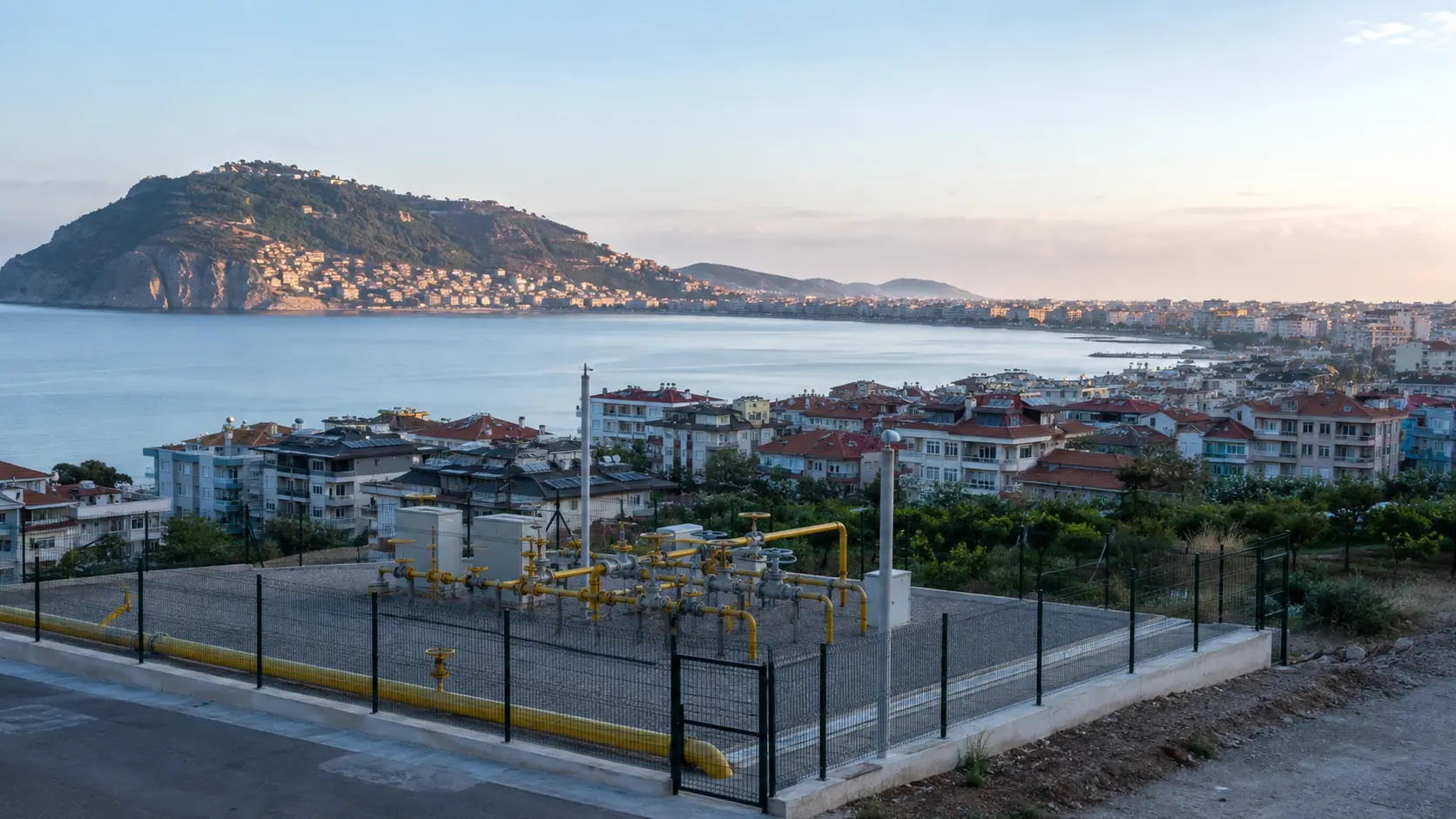
Turkey has taken a formal land-acquisition step for new natural-gas infrastructure in Alanya. Presidential Decision 11639, published in the Official Gazette on 22 August 2026, authorises the Energy Market Regulatory Authority (EPDK) to urgently expropriate 18 properties in Emişbeleni, Payallar and Türkler for an RMS-A station and associated distribution facilities. The decision is significant for the western side of the district, but it is not a timetable for every building to receive gas and it does not establish connection prices.
What the decision legally does
The decision identifies land needed for a pressure-regulation and metering station and related city-distribution infrastructure, and allows EPDK to use the urgent-expropriation procedure for the listed properties. This is a project-enabling land decision. It does not transfer every home to natural gas, approve work inside apartment buildings or replace the permits needed for street excavation and network construction. Owners whose parcels are listed should rely on the official annex and formal notices rather than maps circulated on social media.
Where the affected properties are
The attached list covers 18 properties in Emişbeleni, Payallar and Türkler, three neighbourhoods on Alanya's western corridor. That geographic scope matters: the legal decision is tied to specified parcels and facilities, not to all real estate in Alanya. Residents elsewhere should not infer that their street is included. A parcel can be checked through its block and plot identifiers in the official record, then confirmed with the land registry and the authority conducting the acquisition.
Why an RMS-A station matters
An RMS-A facility is part of the interface between a high-pressure transmission or supply line and a city distribution network. It reduces and regulates pressure, measures gas and supports controlled delivery into the local system. Building this gateway can be necessary before a wider network expands. It is nevertheless only one part of the chain: distribution pipes, municipal coordination, permits, testing, commissioning, building-level installations and subscriptions must follow before a household can use gas.
No automatic connection date for a neighbourhood
EPDK's own consumer guidance explains that a street can depend on the licensed distributor's investment programme, roads opened in line with the zoning plan, established road levels and excavation permissions. Decision 11639 does not publish a street-by-street programme or completion date. Residents should wait for written announcements from the licensed distributor, EPDK or the municipality and should ask about the exact address. A sales agent's statement that gas is 'coming soon' is not equivalent to an approved connection schedule.
What property owners should check
Owners in the named neighbourhoods should first determine whether their own parcel appears in the annex. If it does, obtain the formal notification, valuation record and procedural information and seek independent Turkish legal advice before signing anything. If it does not, the decision alone creates no direct title change. Buyers should still check the title deed, zoning, easements, infrastructure corridors and municipal plans for the exact parcel. Nearby public investment can be relevant without guaranteeing a price rise.
Costs inside a building remain separate
Even after a street network becomes operational, a building may need an approved internal installation, common-owner decisions, ventilation or chimney work, meters, inspection and a supply contract. The final cost varies by building and distributor rules. Tenants should clarify with the owner who pays for conversion and whether the lease permits works. No household should pay an intermediary solely on the strength of this expropriation announcement; fees and contractor credentials should be verified through official channels.
Potential benefits and practical disruption
A functioning gas network can broaden heating and cooking choices and reduce reliance on delivered fuels or electric resistance heating for some households. Construction may also bring temporary excavation, traffic or access disruption. The economic effect depends on tariffs, building efficiency, usage and alternative energy prices. For investors, infrastructure is one due-diligence input alongside legal status, occupancy permit, earthquake performance, maintenance costs, rental demand and seasonal accessibility.
Turkey Compass assessment
The confirmed development is narrow but meaningful: land acquisition has been authorised for a defined Alanya gas-infrastructure project involving 18 properties in three neighbourhoods. The decision improves the project's legal readiness; it does not promise immediate service, a particular tariff or higher property values. Residents should follow the licensed distributor and local authorities for construction and connection milestones. Affected owners should use the official parcel list and obtain legal advice based on their individual title.