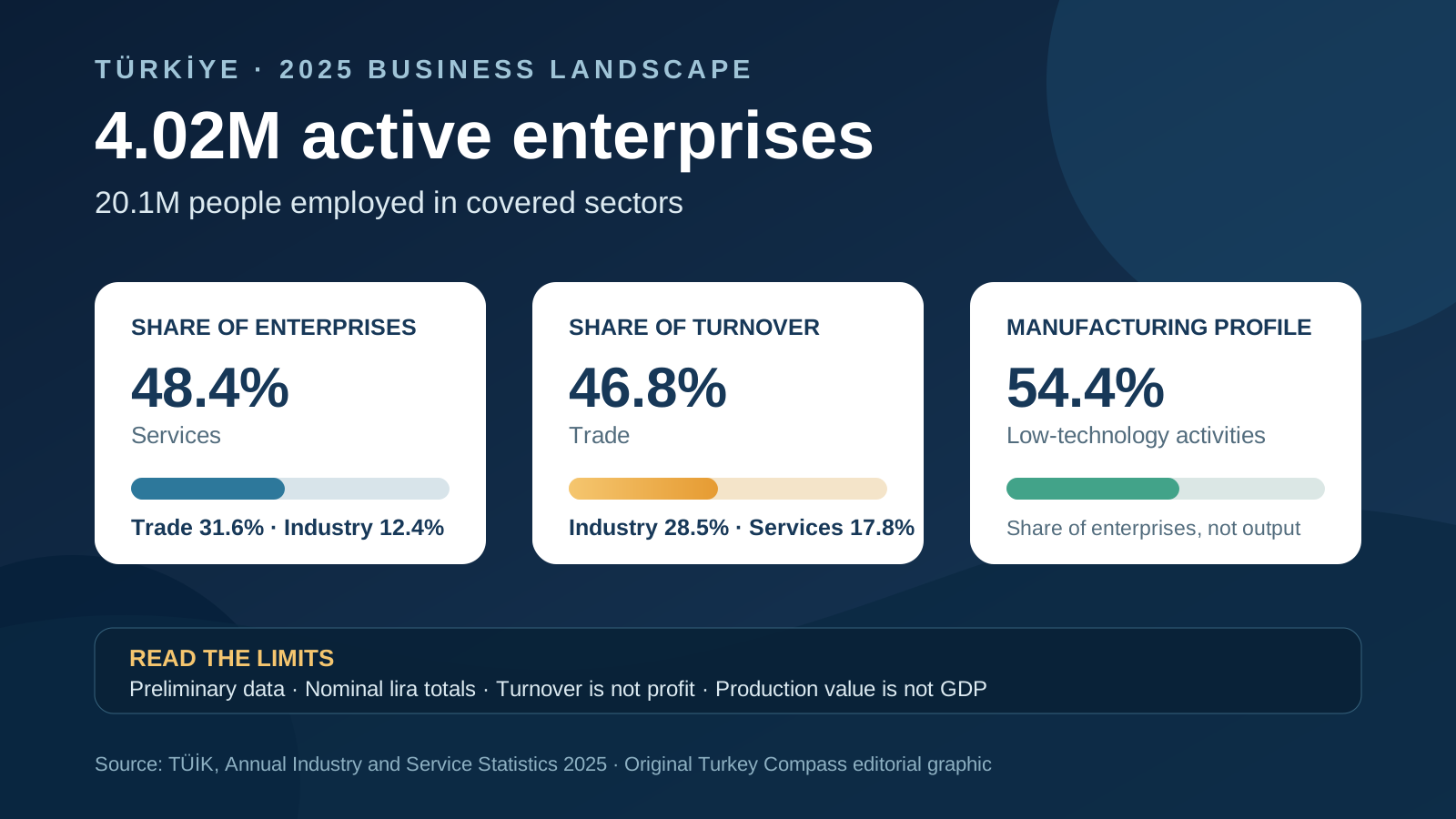
Turkey had 4,016,059 active enterprises and 20,122,817 people employed in the sectors covered by the Annual Industry and Service Statistics in 2025, according to preliminary data released by TÜİK on 27 August 2026. The enterprise count increased by 1.86% from the previous year. For an international investor, the most useful message is not simply that there are more businesses: services and trade account for most operating enterprises, while industry has a much bigger weight in employment and production than its share of company numbers. The figures map the market's structure, but they do not by themselves measure profitability, real growth or the return on a particular acquisition.
Where Turkey's enterprises are concentrated
Services represented 48.4% of active enterprises in scope, trade 31.6% and industry 12.4%. The remainder was spread across construction and other covered activities. This profile matters when entering the market: a foreign founder is joining a dense services-and-commerce ecosystem rather than an economy made up mostly of factories. It can imply a wide customer and supplier base, but also intense competition in activities with relatively low entry barriers. National shares should be followed by province-level research, licence checks and a realistic assessment of how the product will be sold.
Employment gives industry more weight than the company count
Services employed 41.2% of the covered workforce and industry 26.1%. Industry's employment share is therefore more than twice its 12.4% share of enterprises. That points to larger average workforces in industrial establishments and explains why manufacturing, energy and production chains can matter disproportionately to labour demand, regional infrastructure and supplier opportunities. It does not mean every industrial company is large or profitable. Investors should compare establishment size, wage costs, productivity, collective arrangements and skills availability within the exact subsector and province.
Turnover is large, but turnover is not profit
TÜİK reported total turnover of 124.816 trillion Turkish lira for 2025. Trade generated 46.8% of that total, industry 28.5% and services 17.8%. These are nominal annual values in current lira. They should not be described as real growth without a comparable inflation adjustment, and a high-turnover sector can still operate on thin margins. Turnover includes sales activity; it does not subtract wages, financing, imported inputs, rent, tax, depreciation or other costs. A company valuation still needs audited accounts and cash-flow analysis.
Production value highlights manufacturing and logistics
Total production value was 71.351 trillion lira. Manufacturing accounted for 27.886 trillion lira, followed by trade at 9.134 trillion, construction at 7.976 trillion, transport and storage at 6.801 trillion, and electricity, gas, steam and air-conditioning supply at 4.422 trillion. For investors, these figures help locate large operating ecosystems and potential business-to-business demand. Production value is not GDP and should not be added to turnover as a separate market-size total. Sector definitions and value chains overlap economically even when statistical reporting assigns activity to one main classification.
Value added is a better productivity clue, not a ready margin
Factor-cost value added across the covered sectors reached 22.201 trillion lira, while purchases of goods and services totalled 108.507 trillion lira. The distance between headline sales, purchased inputs and value added is a reminder that gross commercial volumes can overstate what remains inside a business. Factor-cost value added is a statistical measure, not the net profit available to owners. For due diligence, compare it with company-level operating margins, working capital, debt, foreign-currency exposure and the share of imported intermediate goods.
The technology profile creates both risk and opportunity
TÜİK classified 54.4% of manufacturing enterprises in low-technology activities. That does not mean 54.4% of manufacturing output is low-tech, because the statistic concerns the number of enterprises, not their production value. It nevertheless flags a productivity and upgrading question. European and international firms may find opportunities in machinery, automation, energy efficiency, software, certification and supplier development. They should also test whether a target's competitiveness rests on technology, scale, labour cost, protected relationships or temporary pricing conditions.
How to use the data in a market-entry decision
Use this release as a map, not a buy signal. First identify the NACE activity that matches the proposed operation and obtain province-level demand, wage and property data. Then check establishment counts, customer concentration, permits, tax treatment, import dependence and access to skilled staff. For an acquisition, request reconciled revenue, profit, tax, payroll and bank records rather than relying on the sector's national turnover. For a greenfield project, model sales in both lira and the relevant input or funding currency. The 1.86% rise in active enterprises shows expansion in the count, not the survival rate or quality of the new cohort.
Turkey Compass assessment
The 2025 preliminary results portray a broad economy led numerically by services and trade, with industry carrying a larger role in jobs and production than its company count suggests. That is useful context for investors choosing a sector, city or supplier strategy. The defensible conclusion is structural, not promotional: Turkey offers a large and diverse operating base, but the published totals do not prove that a specific business is profitable or that nominal turnover grew in real terms. Final results and company-level evidence remain essential.