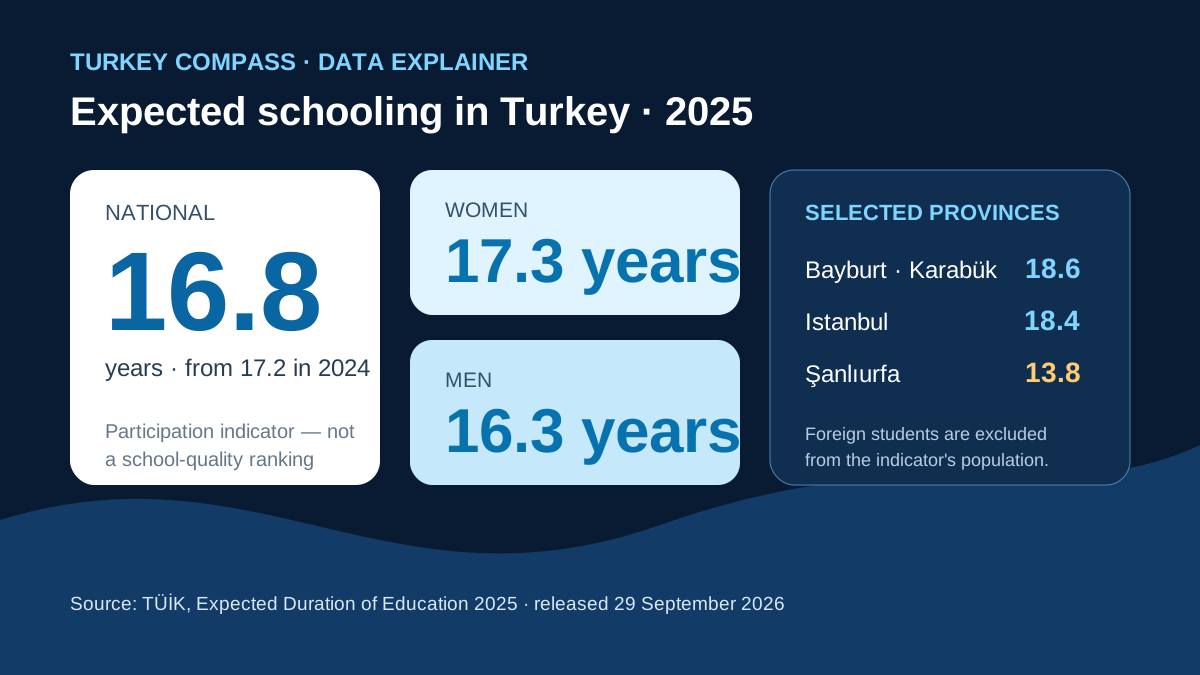
A child starting primary school in Turkey in 2025 could expect to spend 16.8 years in formal education if that year's enrolment patterns continued, TÜİK reported on 29 September 2026. The figure was 17.2 years in 2024. It is a participation-based national indicator, not a prediction for an individual child — and TÜİK's methodology excludes foreign-national residents and foreign students.
The decline is concentrated beyond compulsory school
The overall indicator fell by about 2.3% in one year. The expected contribution from higher education declined from 5.3 years in 2024 to 4.8 years in 2025, accounting for much of the headline movement. This does not mean universities shortened their degree programmes; the measure changes with age-specific enrolment and participation rates.
Women remain ahead in the national indicator
Expected formal schooling was 17.3 years for women and 16.3 years for men. The one-year gap describes the aggregate participation pattern, not the outcome of every pupil or the quality of teaching available to girls and boys in a particular district.
Istanbul is high, but the provincial spread is wide
Bayburt and Karabük recorded the highest total at 18.6 years, followed by Istanbul at 18.4 and Tunceli at 18.3. The lowest values were Şanlıurfa at 13.8, Şırnak at 14.1 and Muş at 14.3. Province results can reflect the age structure, university presence, migration and participation patterns; they are not a league table of individual schools.
Why the statistic does not directly measure an expat child's options
TÜİK states that foreign-national residents and foreign students are outside the indicator's population. International, private and public-school choices for a foreign child therefore require separate checks. Families should verify admission rules, teaching language, diploma recognition, fees, transport, support for Turkish-language learning and the specific school's recent record.
How to use the data when choosing a city
Treat the provincial number as a broad participation signal, then investigate the actual neighbourhood. Compare available schools, commute time, class capacity, tuition and extra charges, university pathways and whether the child's previous records will be accepted. A high provincial score cannot guarantee a place, while a lower score does not prove that every local school is weak.
TÜİK — official press-release catalogue, Education →
TÜİK — Expected Duration of Education 2024, definitions and methodology →