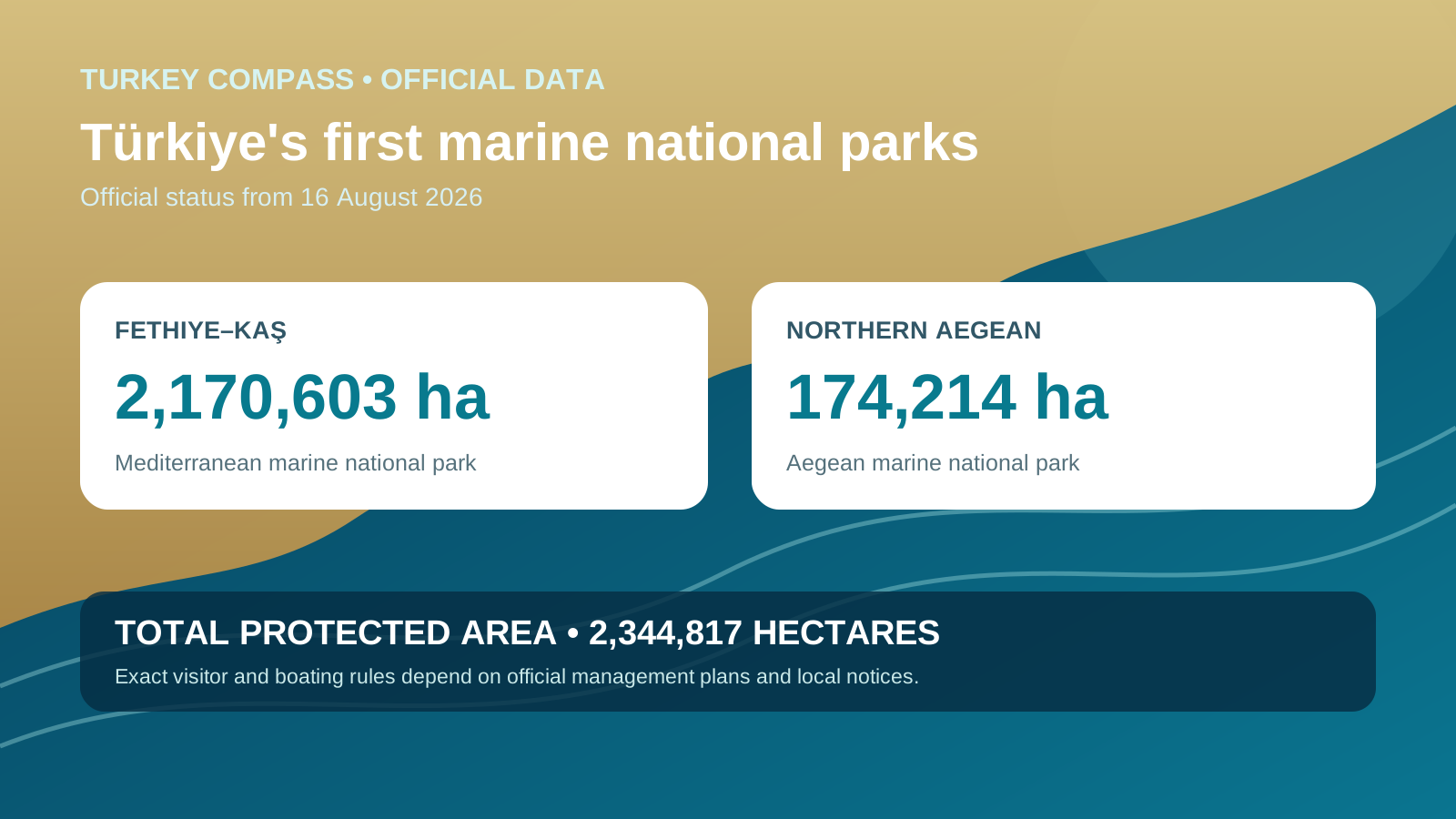
Turkey has given national-park status to two vast marine areas: the Fethiye–Kaş Marine National Park in the Mediterranean and the Northern Aegean Marine National Park. The presidential decisions were published in the Official Gazette on 16 August 2026, and the Ministry of Agriculture and Forestry confirmed the designations on 17 August. Together, the parks cover 2,344,817 hectares, making this a major environmental and coastal-management decision rather than a new tourist attraction with immediately defined ticketing or access rules.
Where the two protected areas are
The larger Fethiye–Kaş park covers 2,170,603 hectares off the coast between Muğla's Fethiye district and Antalya's Kaş district. The Northern Aegean park covers 174,214 hectares. The legal boundaries are set by coordinate lists and maps attached to Official Gazette decisions 11626 and 11627. Travellers, yacht operators and businesses should therefore use the official maps, not a simplified social-media graphic, when determining whether a planned route or activity lies inside a park.
What became legally final
The two areas had appeared as marine conservation areas in Turkey's marine spatial-planning map, which was announced in April 2025 and registered with UNESCO's Intergovernmental Oceanographic Commission in June 2025. National-park designation gives that policy a formal domestic protection status under Turkey's National Parks Law. The Ministry says the new parks will support biodiversity inventories, monitoring, conservation and sustainable use. With the two marine parks, the country reached 52 national parks and 698 protected areas at the time of the announcement.
What the announcement does not yet tell a visitor
The designation itself does not mean that every beach, swimming area, ferry route or marina in the wider region has closed. Nor does it, by itself, provide a complete operating rulebook for anchoring, fishing, diving, water sports, commercial tours or construction. Those practical conditions depend on management plans, existing sector rules, local notices and the exact coordinates. Visitors should avoid claims that all activity is banned or, at the other extreme, that the designation changes nothing.
Checks for sailors, divers and tour operators
Before departure, request current information from the coastguard, harbour master, park administration or licensed operator relevant to the exact location. Verify anchoring zones, speed restrictions, waste-discharge rules, fishing and diving permissions, seasonal wildlife measures and any route-specific notices. A booking platform or old cruising guide may not reflect a new protected status. Operators should also review insurance, passenger information and environmental obligations before advertising an itinerary through either marine park.
Why Fethiye and Kaş visitors should care
The Fethiye–Kaş coastline supports boat tours, sailing, diving, swimming and nature-based travel. Better habitat monitoring and clearer use zones can strengthen the long-term appeal of these destinations if management is transparent and enforcement is consistent. In the short term, however, travellers may encounter changes to where boats can anchor or which activities require permission. A holiday should be planned around the exact bay and operator rather than assuming that one national rule applies identically across more than two million hectares.
What this means for coastal property decisions
National-park status is not a promise that nearby homes will rise in value, and it is not automatic permission for tourism development. Protected landscapes may support destination quality while also creating stricter planning, environmental-assessment or infrastructure constraints. A buyer should check the title deed, zoning plan, shoreline rules, protected-area boundaries, building licence and occupancy permit for the specific parcel. Marketing phrases such as 'next to the new marine park' cannot replace written verification from the competent authorities.
A regional rather than geopolitical reading
The parks have also entered debate about maritime claims in the Aegean and Mediterranean. For travel and investment decisions, the reliable starting point is narrower: Turkey has formally designated two areas under its domestic National Parks Law, with boundaries published in its Official Gazette. The designation should not be treated as a substitute for legal analysis of international maritime disputes. Turkey Compass separates the confirmed conservation decision from political interpretations that require different sources and expertise.
Turkey Compass assessment
The announcement is meaningful because it changes the legal conservation status of a very large part of Turkey's coastal waters and creates a framework for future management. Its immediate practical effect will depend on detailed plans and local implementation. Travellers should confirm current rules shortly before a trip; operators should update compliance procedures; and investors should commission parcel-level planning and environmental checks. The safe conclusion today is that the parks exist and their size is confirmed—not that every future restriction or economic benefit is already known.