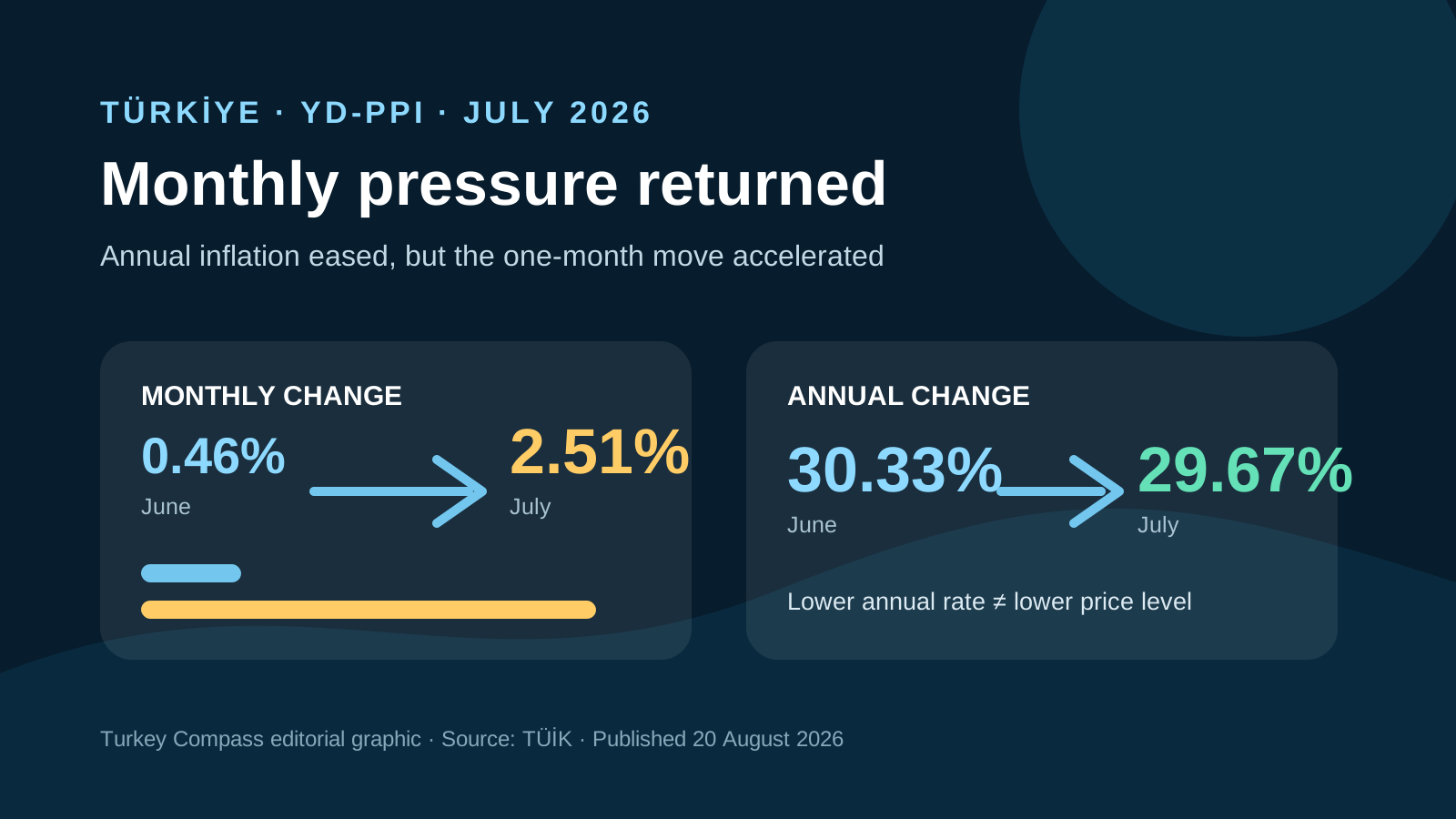
Turkey's Foreign Producer Price Index, which tracks prices of domestically produced goods sold abroad, rose 2.51% in July 2026 from June. The annual increase eased to 29.67%. The two movements are not contradictory: the monthly figure shows a renewed short-term rise, while the annual comparison still reflects a slightly softer pace than a year earlier. For international investors and companies buying from Turkey, the release is useful as a cost and pricing signal, but it is not a forecast for the lira, export volumes or the price of a specific contract.
The important story is the change in momentum
June's official release showed a monthly increase of only 0.46% and an annual rate of 30.33%. July therefore brought a 2.05 percentage-point acceleration in the one-month movement, even as the annual rate fell by 0.66 percentage points. Compared with July 2025, when monthly foreign producer prices rose 3.03% and the annual rate was 30.06%, this July's monthly move was smaller and the annual rate was 0.39 points lower. The release therefore supports neither a simple 'inflation is rising' nor a simple 'inflation is falling' headline.
What the index actually measures
YD-PPI measures producer prices, in Turkish lira, for goods manufactured in Turkey and sold to foreign markets. It covers the producer side of export activity, not retail prices paid by households and not the final invoice of every exporter. Changes can reflect domestic production costs, exchange-rate movements, commodity prices and the composition of exported goods. A supplier may face very different labour, energy, imported-input and financing costs from the national average. Buyers should therefore treat the index as a benchmark for questions, not as an automatic adjustment formula.
Why annual easing can coexist with a strong month
Annual inflation compares July 2026 with July 2025, whereas monthly inflation compares July with June 2026. A strong monthly rise can occur while the annual rate declines if the month dropping out of the twelve-month calculation was stronger, or if cumulative movements across the rest of the year were softer. This base-effect arithmetic matters because an annual decline describes a slower rate of increase, not a fall in the price level. Export producer prices are still higher than a year ago; they simply rose at a slightly slower annual pace.
Implications for exporters and foreign buyers
For exporters, faster monthly producer-price growth can put pressure on margins when sales contracts are fixed in foreign currency and input costs adjust more quickly than selling prices. For overseas buyers, it can appear in revised quotations, shorter price-validity periods or requests to renegotiate indexation clauses. The effect will not be uniform: firms with domestic inputs, strong productivity or natural foreign-currency hedges may react differently from businesses dependent on imported materials or expensive credit. Procurement teams should compare several supplier quotes and document exactly which cost component has changed.
What investors should monitor next
Investors should compare YD-PPI with export volumes, manufacturing output, capacity utilisation, company margins and exchange-rate developments. If export prices rise while volumes and margins weaken, competitiveness may be under pressure. If prices, volumes and productivity rise together, the interpretation is different. One month cannot establish a trend, so the August release and company-level results will matter. The official index is also revised and published on a national basis; it cannot identify the performance of a single listed company, industrial zone or export destination.
This is not a household inflation reading
People living in Turkey should not use the 29.67% annual figure as a personal cost-of-living rate. Consumer inflation measures a different basket, while rent, food, schools, health care and transport follow their own dynamics. YD-PPI can influence the wider economy indirectly through production costs, currency demand and company pricing, but the transmission is neither immediate nor one-to-one. A household budget should use current local quotations and consumer-price data, not an export producer index designed for another statistical purpose.
A practical decision checklist
Businesses reviewing a Turkey-linked purchase or investment should record the quotation currency, price-validity period, indexation clause, imported-input exposure, payment schedule, delivery terms and financing cost. Model a base case plus stronger and weaker lira scenarios, and distinguish a change in nominal lira prices from a change in euro or dollar costs. Verify the next official release before renewing a long contract. Turkey Compass's conclusion is cautious: annual export-price inflation eased, but July's monthly acceleration is a real signal that short-term pricing pressure has not disappeared.