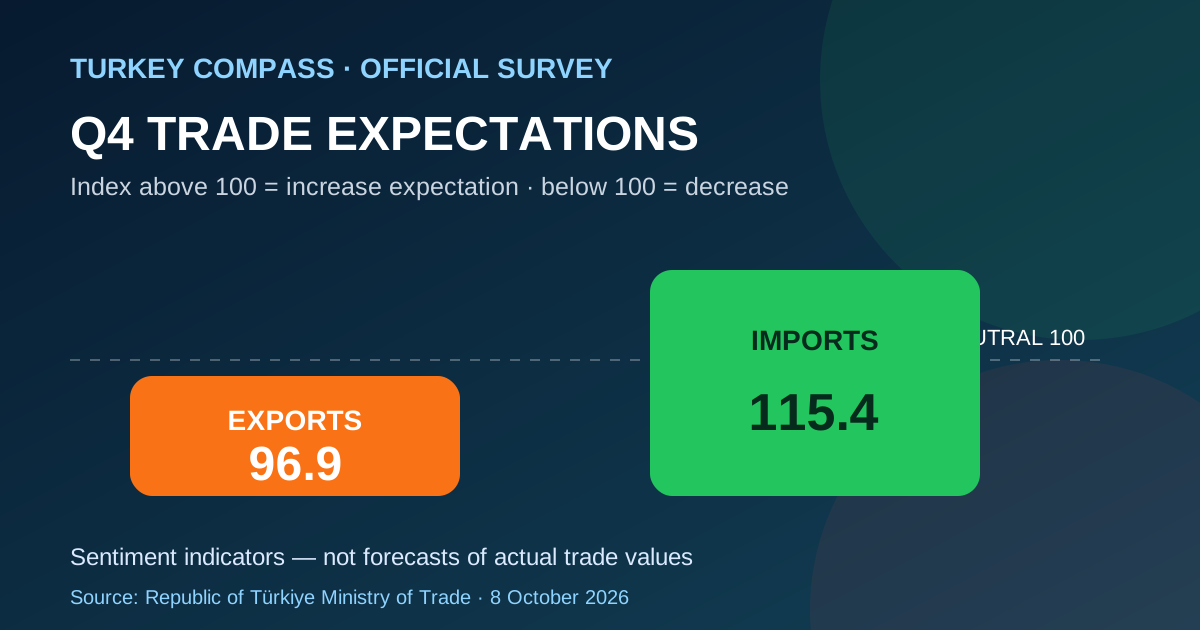
Turkey's official fourth-quarter trade survey points in two directions: the Export Expectations Index stands at 96.9, below the neutral level of 100, while the Import Expectations Index is 115.4. The Ministry of Trade published the results on 8 October after surveying firms from 1 to 16 September. For international investors, the gap is a useful early signal about orders, input demand and costs, but it is not a forecast of actual trade values or proof that the goods deficit will widen.
How to read 96.9 and 115.4
In the ministry's diffusion indexes, a result above 100 indicates an expectation of increase, below 100 an expectation of decrease and exactly 100 no change. The export index at 96.9 therefore signals mild overall caution, while the import index at 115.4 points to a clearer expansionary expectation. These composite indexes weight answers by firms' export or import values; they are not percentage changes and cannot be subtracted to estimate a future deficit.
Export expectations are better than the headline alone suggests
The export index was pulled down by the current registered order level and the direction of orders over the previous three months. Yet the components for exports and export orders over the next three months contributed positively. Among exporting respondents, 37.5% expected exports to rise and 17.4% expected a fall. The survey therefore combines weak recent order momentum with a more constructive view of the coming quarter rather than showing a uniform contraction call.
European demand remains a positive balance
Among respondents, 27.6% expected exports to European countries to increase and 16.3% expected them to decrease. Firms named the United States, Australia and Germany as the top three markets in which they planned to export for the first time during the next three months. This is useful for market-entry and supplier discussions, but the survey does not give product-level values or guarantee that planned first shipments will occur.
Imports point to volumes and prices moving up
All four components of the import index pushed it higher: three-month import expectations, expected import unit prices, current registered orders and orders over the previous three months. In unweighted response shares, 29.1% expected imports to increase, 49.0% expected no change and 16.7% expected a decrease. The index can rise even when the largest single group chooses 'unchanged' because diffusion measures use the balance of answers and weight firms by trade values.
Costs remain the central operating constraint
Exporters most often identified high logistics costs, cited by 85.6%, followed by financing costs at 82.5% and adverse exchange-rate effects at 78.6%. Importers most often said they bought from abroad because there was no domestic production, at 60.1%, or insufficient domestic output, at 46.5%. Investors should compare these signals with final customs data, sector order books, exchange rates and financing conditions before changing revenue or margin assumptions.
The sample is broad, but the release is still a survey
The ministry sent the questionnaire to 1,562 firms and received 1,228 responses, a 78.6% response rate. Respondents represented 45.6% of annualised exports and 53.8% of annualised imports according to the reference data stated in the report. That coverage makes the indicator relevant, but it does not remove response bias, seasonal effects or the difference between intentions and completed customs declarations.