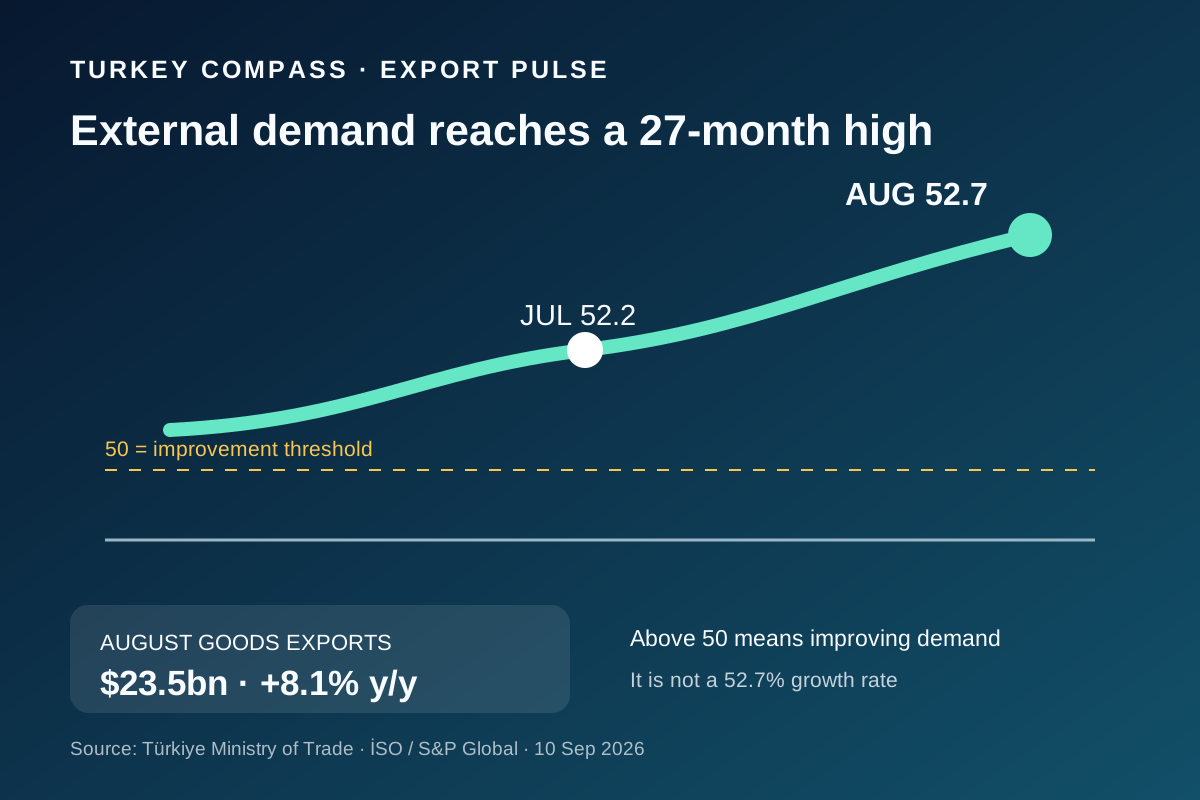
Demand conditions in Turkey's manufacturing export markets improved at the fastest pace in 27 months in August 2026. The Ministry of Trade said the İSO/S&P Global export climate index increased from 52.2 in July to 52.7, its fourth consecutive monthly rise and highest level since May 2024. Readings above 50 indicate improvement, not a 52.7% growth rate. For international investors and suppliers, the release strengthens the external-demand signal, but it should be read alongside Turkey's own July industrial production decline and company-level order books.
The index strengthened through the third quarter
The index has remained above 50 since January 2024. Its average was 51.5 in the first quarter of 2026 and 50.3 in the second; the July–August average rose to 52.5. That sequence suggests that export-market demand regained momentum in the third quarter. It does not measure Turkish factory output directly: it combines purchasing-managers' data from the countries that buy Turkish manufactured goods.
The US, Germany and the UK supplied broad support
The United States, which the ministry says accounts for about 6% of Turkey's manufacturing exports, recorded its fastest output growth since April 2022. Germany and the United Kingdom expanded for a second consecutive month and at a faster pace than in July. This is relevant to Turkish automotive, machinery, textiles and other suppliers, although the national index does not reveal demand for a particular product, customs code or exporter.
Middle East demand improved unevenly
The ministry described stronger activity in the United Arab Emirates, Saudi Arabia and Kuwait, while Qatar and Egypt remained in contraction. Investors should therefore avoid treating the region as one market. Orders, payment terms, sanctions exposure, logistics and currency risk still need country- and counterparty-level checks.
August exports set a monthly record
Turkey's August goods exports rose 8.1% from a year earlier to $23.5 billion, a record for the month. Annualised exports reached $280.3 billion, compared with the government's $282 billion 2026 programme target. That leaves a $1.7 billion gap to the target, but the comparison is not a forecast and the separate August trade release also showed imports growing faster than exports.
What investors should—and should not—conclude
Exporters can compare the index with new orders, capacity use, delivery times and customer concentration. Investors should test margins, working-capital needs and foreign-currency exposure rather than extrapolating from one survey. The export climate index is not Turkey's industrial production index, a lira forecast, a property-price indicator or proof of company profitability. The defensible conclusion is simply that external demand conditions improved broadly and reached their strongest reading in 27 months.