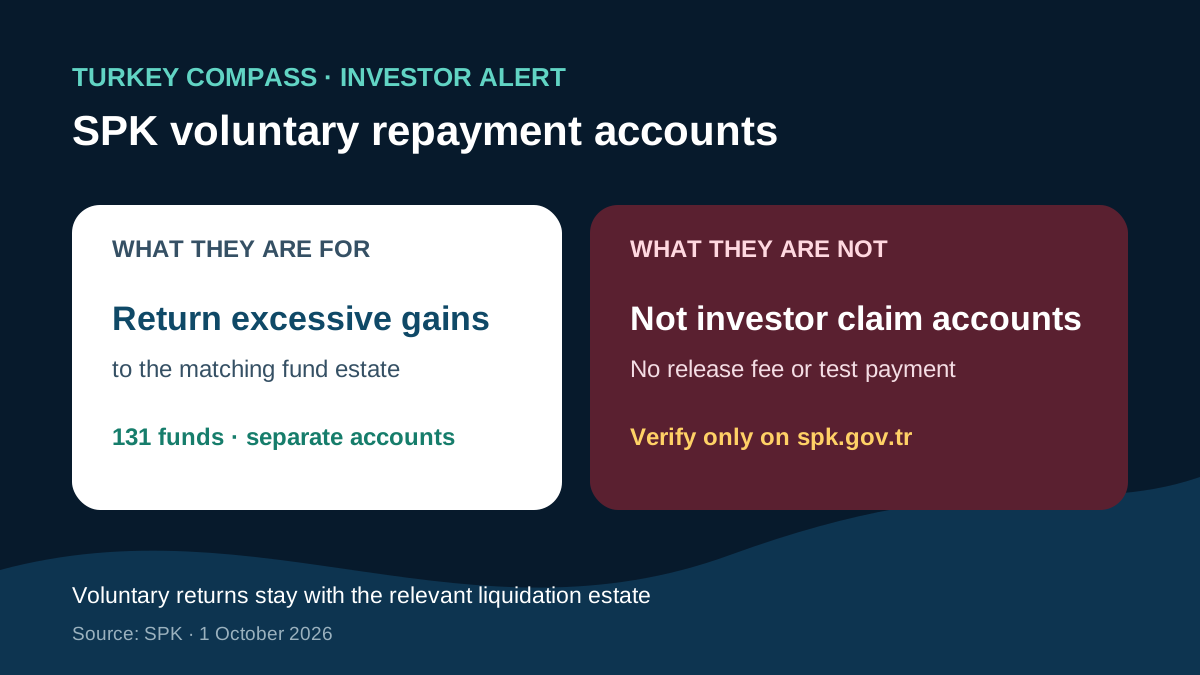
Turkey's Capital Markets Board (SPK) said on 1 October that separate voluntary repayment accounts had been opened for funds placed into liquidation. The accounts are designed for people who sold fund participation units before the liquidation decision and now wish, on their own initiative, to return what the regulator describes as excessive gains. This is the central practical distinction: an ordinary holder of one of the 131 liquidating funds is not being asked to deposit money, pay a release charge or file a claim through these accounts. Any account details must be checked only on the official SPK page, not in a screenshot, message or social-media post.
What the 1 October notice created
SPK says an individual account has been opened for each affected fund at Birleşik Fon Bankası in the name of the Savings Deposit Insurance Fund, known in Turkey as TMSF. A person who made an excessive gain through sales of that fund's participation units before liquidation may voluntarily return the relevant amount to the matching fund account. The notice also creates a separate General Share Repayment Account for people who want to return excessive profits from transactions in listed company shares or similar dealings. The announcement does not impose a general levy on fundholders and does not describe the accounts as a compulsory payment channel.
Why ordinary fundholders should not transfer money
The accounts receive voluntary repayments from profit-makers; they are not application, identity-verification or payout accounts for investors whose units are now in liquidation. A holder does not improve a recovery claim by sending money, and the SPK notice sets no processing fee, unlocking charge or priority-payment contribution. Anyone contacted by a person claiming that a transfer is required to release a fund balance should stop and verify the request with the licensed bank or broker shown on the account statement. Passwords, SMS codes and identity photographs should never be handed to an unsolicited intermediary.
How a repayment enters the liquidation estate
A voluntary amount paid into a fund-specific account may be added only to that fund's liquidation estate, SPK says. It cannot be moved to another fund or a different account. The money is then to be transferred to Ziraat Bankası or Türkiye İş Bankası, the banks assigned to conduct the relevant liquidations, so it can be used in payments to participation-unit holders. This structure does not establish how much any one investor will recover. The eventual result still depends on the assets, liabilities, sale proceeds, expenses, restrictions and verified unit records of the particular fund.
The wider process covers 455,758 investors
In a 23 September clarification, SPK said the liquidation decisions cover 131 funds founded by seven portfolio-management companies and 455,758 unique investors. That figure measures investors recorded across the affected set, not 455,758 new applicants for the voluntary accounts. It also should not be read as a payout forecast. International investors should match the exact fund code and full legal name on their custody statement with the official list because similar-looking fund names, screenshots and copied IBANs create avoidable transfer and fraud risk.
The six-month period is a ceiling, not a payment date
SPK extended one procedural period in the liquidation rules from three months to six on 21 September. The regulator said the extra time is intended to allow portfolio assets to be sold under conditions that better reflect their structure and the market, while also stressing that a liquidation can finish earlier. The six months therefore do not create a universal waiting period, maturity date or deadline by which every holder must receive cash. Staged distributions may occur according to the appointed bank's plan when reconciled cash becomes available.
What a non-resident investor should check
A holder living abroad should first confirm that the licensed intermediary has the current telephone number, e-mail address, tax details and bank account on file. Ask in writing for the exact fund code, number of units, status of any order and the official channel for future liquidation payments. Keep the dated custody statement and the reply. Foreign tax residence, currency conversion, bank-access restrictions and transfer charges are separate issues that the voluntary-repayment notice does not resolve. Any eventual lira payment should be assessed after fees and exchange-rate movement in the investor's home currency.
Use the official page, not a copied account list
SPK's announcement publishes the fund-by-fund account information and the general share account. Turkey Compass is deliberately not reproducing that long list: a copied number can become outdated, lose its fund label or be maliciously altered. Anyone who genuinely falls within the voluntary-return purpose should open the announcement directly on the spk.gov.tr domain, compare the legal fund title and then obtain professional advice before transferring. Ordinary holders who are waiting for liquidation proceeds have no reason in this notice to select an IBAN or send a test payment.
What the notice does not promise
The announcement does not identify individual excessive-profit recipients, determine that every profitable trade was improper or specify how a voluntary amount should be calculated. It also does not promise full recovery, a guaranteed net asset value, a personal payment date or immunity from tax and legal consequences. Investors should follow SPK, the relevant KAP fund page, the appointed liquidation bank and their licensed distributor for account-specific information. The earlier Turkey Compass explainer on the 131-fund liquidation remains the practical guide to order treatment and documentation; the 1 October notice adds a possible source of money to each estate, not a new claim procedure.
SPK — voluntary repayment accounts notice, 1 October 2026 →
SPK — investor count for funds in liquidation, 23 September 2026 →
SPK — liquidation-period amendment, 21 September 2026 →
SPK — TEFAS order and liquidation clarification, 28 September 2026 →