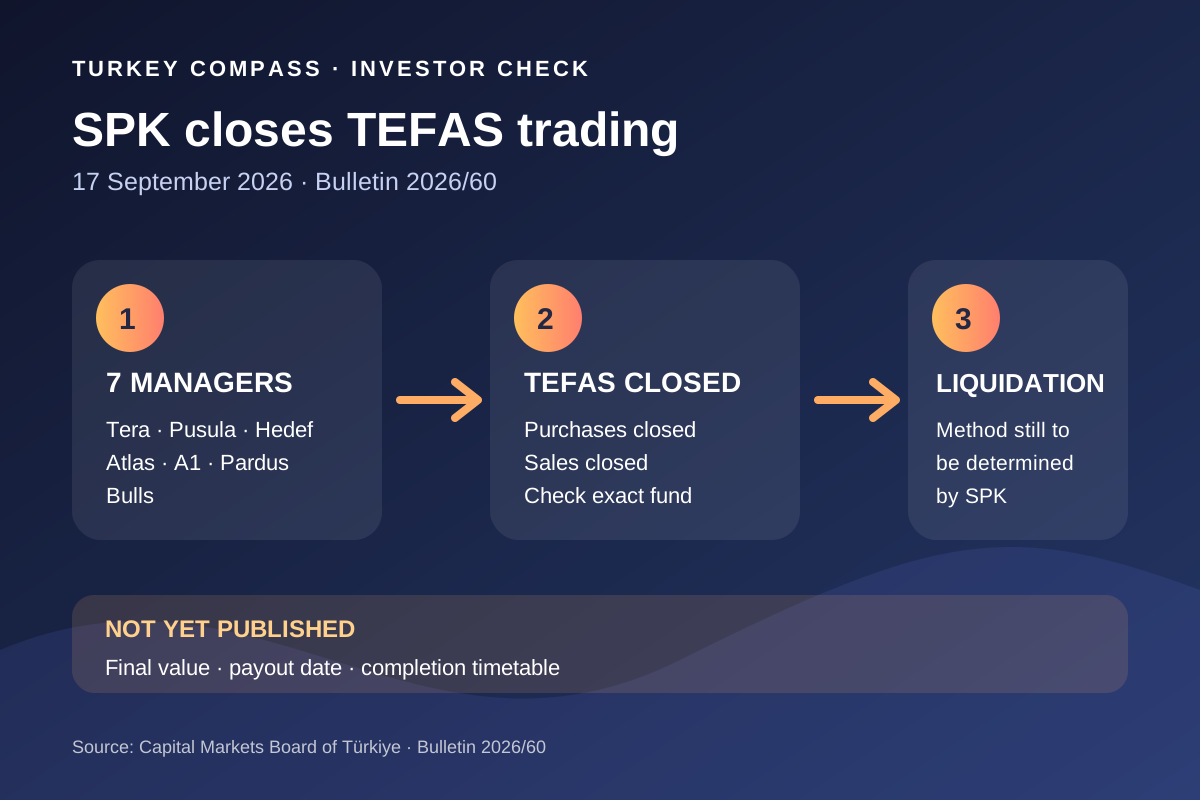
A nine-article bill submitted to Turkey's parliament on 9 October 2026 proposes a special framework for the investment funds placed into liquidation by the SPK decisions of 17 September and still unfinished when the law would take effect. Bill No. 2/3939 includes interim advances of up to TRY 1 million, asset-recovery accounts and claims against responsible parties. The proposal is now before the Plan and Budget Committee: it is not yet law, does not itself credit an investor account and sets no personal payment date. Separately, payments for 17 A1 Capital, Bulls and Pardus funds have already moved from Ziraat Bankası to the relevant banks and brokers under the existing process.
The bill is in committee, not in force
The official TBMM record lists Bill No. 2/3939 as received on 9 October 2026 and currently in the Plan and Budget Committee, with the Justice Committee and the Industry, Trade, Energy, Natural Resources, Information and Technology Committee acting as secondary committees. The text may change during committee or plenary debate and would need parliamentary approval and publication before becoming law. Investors should not treat the TRY 1 million figure as an approved entitlement or a transfer date.
What the nine-article proposal would do
The bill is limited to the 131 funds covered by the SPK's 17 September decisions whose liquidation remains unfinished when the law is published. It would let the SPK coordinate special sale methods, reconcile holders across MKK, Takasbank, TEFAS, custodians and distributors, and use recovered assets for investors. Where cash is insufficient, MKK would calculate a net investment amount by updating cash flows with the arithmetic average of CPI and domestic PPI changes and applying first-in-first-out to withdrawals. An interim advance could be paid up to TRY 1 million and deducted from the final settlement; it would not be an extra compensation payment.
No general taxpayer guarantee is proposed
The bill's justification says payments would come from each fund's liquidation estate plus amounts recovered, collected or voluntarily returned, not from the public budget. It proposes fund-specific recovery subaccounts at TMSF and allows claims against portfolio-management companies and other persons found responsible. People whom SPK identifies as having committed or assisted market-abuse offences would be excluded from the special payment mechanism. These are proposed legal tools, not findings about every investor or a promise of full recovery.
What changed on 8 October
The official statement says the liquidation process for 17 A1 Capital, Bulls and Pardus funds has reached its final stage and that Ziraat Bankası has transferred investor-payment amounts to the relevant banks and brokerages. Those institutions are expected to credit investors as quickly as possible. The statement does not publish a universal hour, confirm that every personal account is already credited or invite investors to pay a processing fee. Holders should check the licensed institution where the fund units were recorded and keep the transaction notice.
A narrower SPK advance already exists
Separate from the parliamentary bill, SPK's 1 October decision applies to funds founded by Tera Portföy, Pusula Portföy, Atlas Portföy and Hedef Portföy whose liquidation began under the 17 September decisions. All participation-unit holders whose reconciliation has been completed are included. MKK determines each person's net investment from the reconciled records. The announcement does not require a separate application or fee and does not provide a bank-by-bank payment calendar.
The TRY 1 million cap is per investor and per fund
For each fund separately, a holder with a net investment below TRY 1 million is to receive that net amount; a holder at or above TRY 1 million is to receive no more than TRY 1 million as the interim payment. This is an advance against the final liquidation amount, not a guaranteed minimum recovery or an extra payment. No units are surrendered for the advance; they will be returned only when the final liquidation payments are made. SPK says implementation will start with money-market funds.
Different rules for A1 Capital, Bulls and Pardus funds
A separate SPK decision says liquidation for these three founders will begin with funds whose title contains 'money market', then proceed from the largest investor count to the smallest. Funds outside liquidation but suspended on all TEFAS and non-TEFAS channels may reopen simultaneously after liquidation ends, with timing and dealing rules set by the founder according to portfolio structure, liquidity, market conditions and investor interests. A non-liquidating suspended fund that traded with a liquidating fund may be reopened earlier by the bank conducting the liquidation. The notice gives no automatic reopening date.
Which bank is responsible
SPK assigned Tera Portföy funds to Turkey İş Bankası. Ziraat Bankası is responsible for funds founded by A1 Capital Portföy, Atlas Portföy, Bulls Portföy, Hedef Portföy, Pardus Portföy and Pusula Portföy. The banks are authorised to perform the work required of a fund founder for the liquidation while retaining their custodian duties. This appointment does not make either bank a guarantor of the funds' market value or liabilities.
Two business days for unit records
Within two business days after the rules take effect, MKK and the banks must reconcile each fund's total outstanding participation units with investors' individual custody records. The check also covers pledges, attachments, injunctions, other restrictions and unexecuted orders. Holders should keep a dated statement showing the exact fund code, full legal name, number of units and any pending redemption instruction so discrepancies can be raised through the licensed intermediary.
Ten business days for assets, debts and expenses
Financial assets subject to custody will sit at Takasbank under the appointed banks' accounts. The former custodian, the bank and Takasbank must reconcile fund receivables and liabilities; the fund service unit is also involved for expenses. Bulletin 2026/61 says these steps must be completed no later than ten business days after the Board decision. This is an operational reconciliation deadline, not a promise that every investor will be paid within ten days.
Minister puts the scope at 131 of 2,038 funds
In an NTV interview on 18 September, Finance Minister Mehmet Şimşek said 131 of Turkey's 2,038 funds were involved and represented roughly 10–11% of fund assets, while about 90% of the market continued operating normally. He described the episode as a limited credit and liquidity problem rather than a system-wide structural risk. This is the government's market-level assessment; it is not a guarantee of any holder's recovery, net asset value, access date or protection from further volatility.
How sales and payments are meant to work
The banks may sell portfolio assets at a frequency they set while considering investor interests, market depth and liquidity. Cash from maturing instruments and asset sales may be managed in money-market instruments under the bank's payment plan. At periods set by the banks, available cash is to be transferred to reconciled individual custody accounts in proportion to fund-unit ownership. The procedure therefore allows staged payments; it does not fix a universal date, amount or recovery percentage.
What happened to orders submitted on 16 and 17 September
SPK's 28 September clarification supersedes the earlier reading of the 13:30 cutoff. Only TEFAS purchase and redemption orders submitted on or before 16 September entered ordinary settlement. Every order submitted on 17 September was cancelled by TEFAS because the affected funds had been closed to platform trading that day. Holders behind those cancelled orders remain participants in the liquidation and are to receive their proportional share of the liquidation balance. Orders submitted by 16 September but left unexecuted because the fund defaulted or did not publish a price are also included in the liquidation process. Ask the licensed distributor for the timestamp and final status of a specific order.
What a holder can document now
Save the latest account statement, fund code and full title, number of participation units, transaction history and any pending orders. Ask the bank or brokerage in writing whether the order was accepted, rejected or remains pending, and request the official notice that governs the answer. Keep the response together with the SPK bulletin. Do not send money, passwords or identity images to people claiming they can release a frozen fund. SPK's decision does not create a private fast-track service or require payment to an intermediary.
Why SPK says the broader fund rules changed
In a separate statement on 18 September, SPK said monitoring in late 2025 found that some funds, particularly free and money-market funds, were involved in price moves in low-free-float shares that could not be explained by economic or fundamental developments. The Financial Stability Committee discussed the issue on 2 December 2025 and an SPK working group began the next day. SPK then raised the financial-assets threshold for qualified investors from TRY 1 million to TRY 10 million on 18 December, implemented revised TEFAS principles on 20 July 2026 and changed how listed real-estate and venture-capital fund holdings are valued after 31 July before publishing the final guide on 28 August. SPK says the wider package is meant to curb manipulation and unsecured related-party borrowing, improve transparency and protect savings. This background does not alter the appointed banks, reconciliation stages or payment rules for the 131 funds under Bulletin 2026/61, and it does not guarantee recovery.
The same bulletin temporarily changes margin maintenance
A separate part of Bulletin 2026/60 allows brokers, within their own risk policies and while considering customer requests, to apply a minimum maintenance-equity ratio of 20% instead of 35% for margin transactions until the close of the 2 October 2026 session, unless SPK announces otherwise. This is flexibility, not an instruction that every broker must lower every customer's requirement. It also does not cancel losses, margin calls, open orders or the broker's stricter contractual risk limits.
Extra checks for international and non-resident investors
A non-resident may face additional questions about bank access, tax residence, currency conversion and receiving Turkish-lira proceeds. None of those issues is settled by the bulletin. Confirm the registered account, contact details and payment channel with the licensed intermediary, especially if the original investment was funded from abroad. Calculate any eventual result in both lira and the home currency, including transfer charges and exchange-rate movement, rather than reading a lira valuation as a guaranteed euro, dollar or sterling outcome.
Six months is a ceiling, not a required wait
SPK's 20 September decision changes the maximum procedural period in item A/8 from three months to six. The regulator says the longer window is intended to let portfolio assets be sold under more suitable conditions, taking portfolio structure and market conditions into account. It also states that liquidation may finish earlier; six months is not a compulsory waiting period. All other rules remain unchanged. Investors should monitor the fund's KAP page, appointed bank, distributor and official SPK notices for the actual payment plan, because the new ceiling still does not guarantee a personal cash-access date, amount or recovery percentage.
Grand National Assembly of Turkey — Bill No. 2/3939 and parliamentary status, 9 October 2026 →
Capital Markets Board of Turkey (SPK) — interim-payment announcement, 1 October 2026 →
Capital Markets Board of Turkey (SPK) — TEFAS order clarification, 28 September 2026 →
Capital Markets Board of Turkey (SPK) — liquidation duration update, 21 September 2026 →
Capital Markets Board of Turkey (SPK) — Bulletin No. 2026/61, 17 September 2026 →
Capital Markets Board of Turkey (SPK) — Bulletin No. 2026/60, 17 September 2026 →
Capital Markets Board of Turkey (SPK) — press announcement, 17 September 2026 →
Capital Markets Board of Turkey (SPK) — fund guide process statement, 18 September 2026 →
Finance Minister Mehmet Şimşek — NTV interview remarks reported 18 September 2026 →
Borsa Istanbul — official TEFAS financial-literacy explainer →