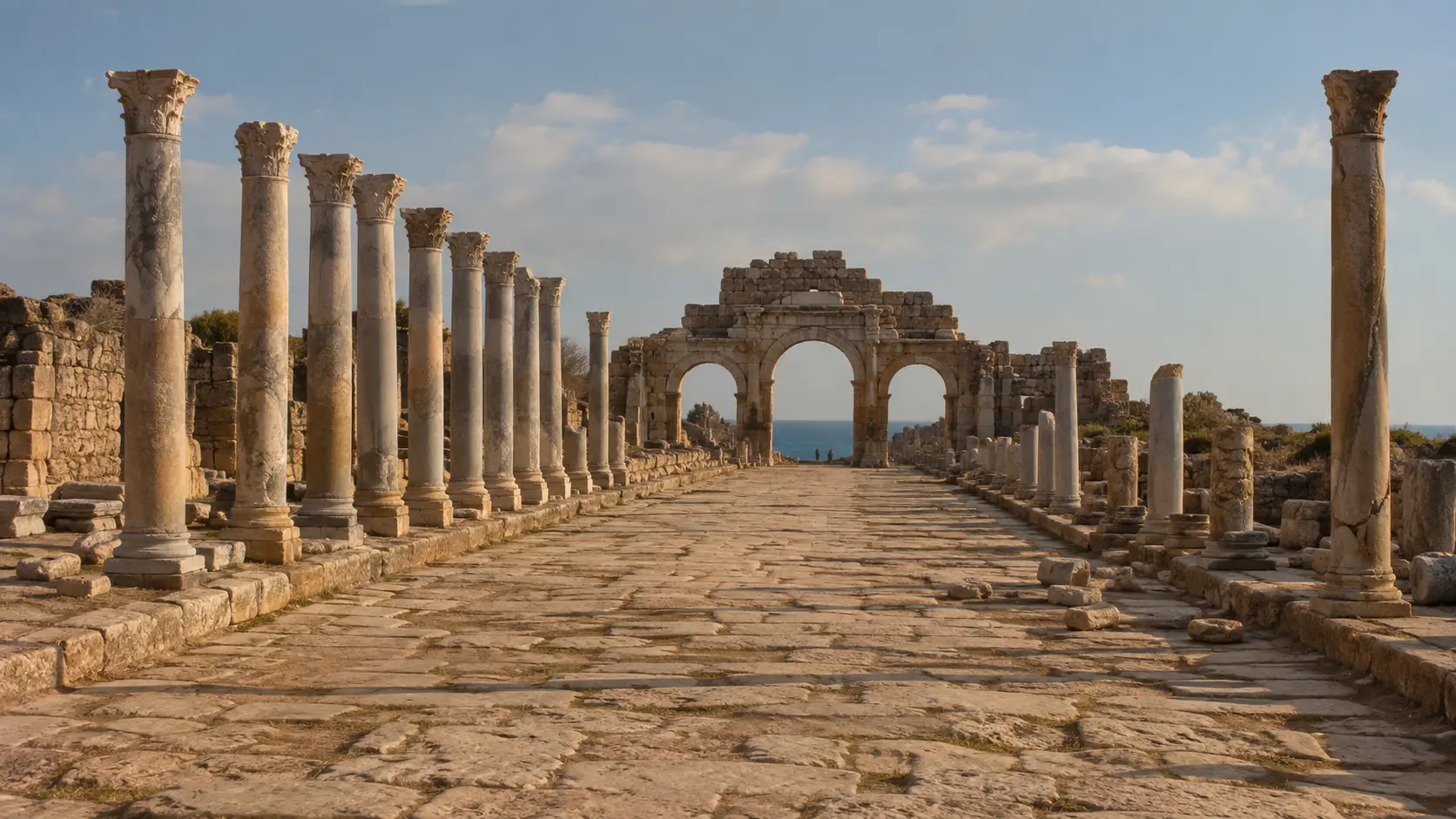
Turkey's Ministry of Culture and Tourism announced on 26 August 2026 that excavation of a roughly 390-metre monumental avenue in Side Ancient City has been completed. The work traces the route between the north-west corner of the gymnasium and the East Gate and brings renewed attention to Heracles Gate, whose reused reliefs depict the Twelve Labours of Heracles and several deities. It is a substantial archaeological result in one of Antalya's best-known heritage destinations, but the announcement is not itself a notice that every newly excavated section is immediately open to visitors.
What the excavation established
The avenue known in the excavation record as b Street was one of Side's important urban axes. Archaeologists identified a northern colonnade, rooms behind it and three monumental entrances: the West Gate, Heracles Gate and the North Bath Gate. Together, the finds allow visitors and researchers to read several construction phases on the same route rather than viewing the street as a single-period monument.
Why Heracles Gate stands out
Reliefs on architectural blocks show the Twelve Labours of Heracles, while coffered elements carry depictions of Athena, Zeus, Artemis, Hygieia and Tyche. The ministry dates the reliefs to the early third century CE and says they were reused when Heracles Gate was built in Late Antiquity. That distinction matters: the carvings and the gate do not necessarily belong to the same original construction phase.
The avenue changed in the fifth century
According to the official account, the northern side of the avenue was reorganised when the Episcopal Palace complex developed in the fifth century. Some earlier entrances from the colonnade were closed and new monumental gateways were formed. The route from the East Gate therefore became a ceremonial urban approach as well as a transport corridor, showing how Side's civic landscape adapted after the Roman period.
What travellers should not assume yet
The ministry confirms completion of the excavation, not a new opening date, ticket category or unrestricted walking route through every exposed area. Conservation, safety work or site management may affect access to individual structures. Before travelling specifically for the avenue or the reliefs, check the current information from Side Museum, the official museum ticket system or the local cultural heritage authority.
How to plan a heritage-focused visit
Side contains monuments from different periods across a broad archaeological landscape. Allow time beyond the theatre and waterfront, use sun protection and suitable footwear, and avoid touching or climbing on exposed stonework. Travellers who need step-free access should verify the exact route in advance because archaeological surfaces can be uneven and a newly excavated feature does not automatically have a visitor path.
Turkey Compass assessment
The discovery is newsworthy because a continuous 390-metre axis now offers clearer evidence of Side's transition from the Roman era to Late Antiquity. Its value is archaeological and interpretive; it should not be turned into an unsupported claim about a completely new attraction or guaranteed public access. For visitors, the practical step is to confirm the live route and opening conditions shortly before arrival.