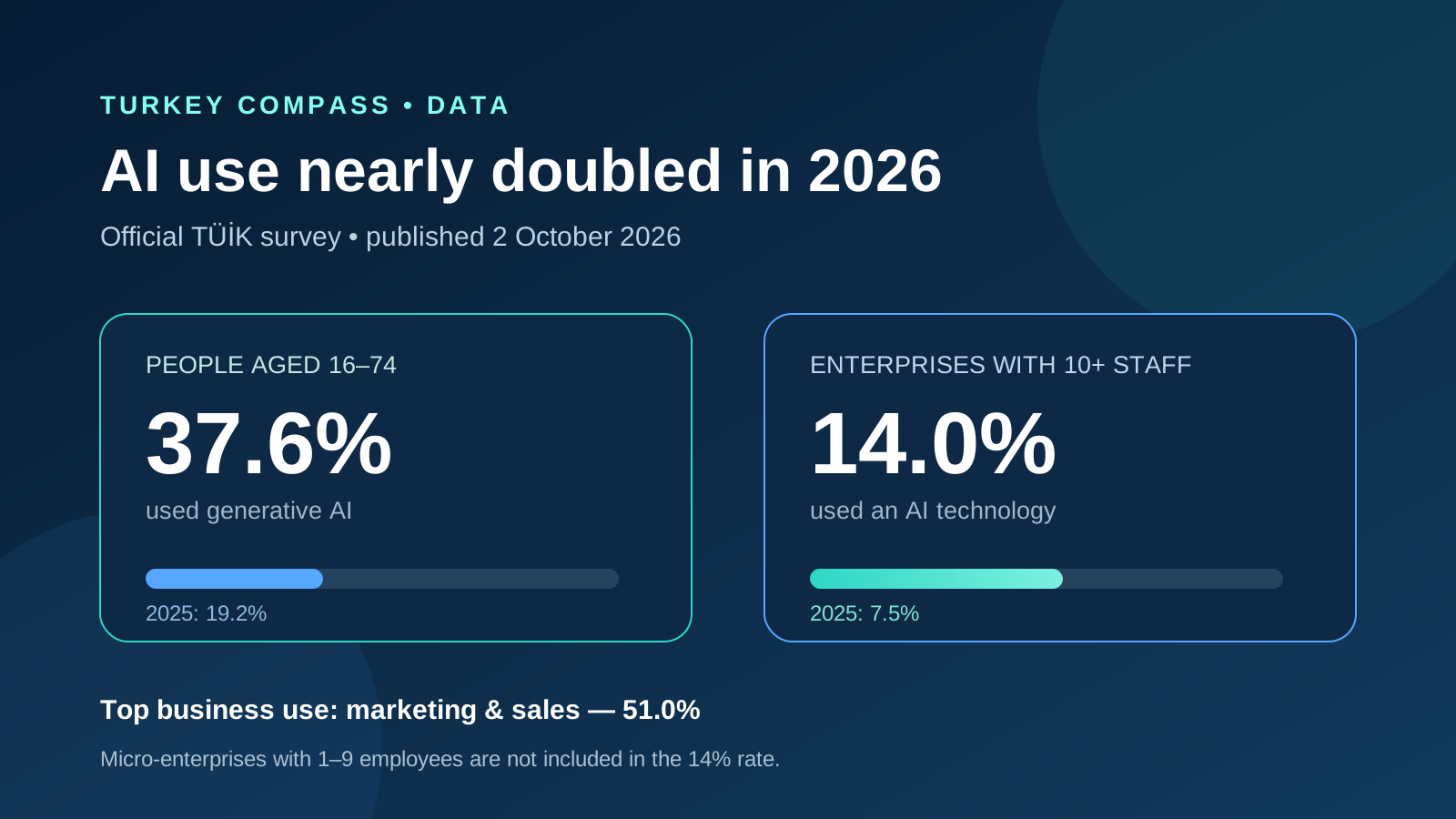
Turkey's official statistics agency reports a rapid rise in artificial-intelligence use, but the two headline rates measure different populations. Generative-AI use among people aged 16–74 rose from 19.2% in 2025 to 37.6% in 2026. Among enterprises with at least 10 employees, the share using any AI technology increased from 7.5% to 14.0%. International investors should read the second figure as a survey of covered enterprises, not every business in Turkey.
Who is included in the survey
The individual results cover people aged 16–74. The enterprise results cover businesses with 10 or more employees, so firms with one to nine employees are outside that headline rate. The individual measure is specifically generative AI; the enterprise measure covers any listed AI technology. The two percentages therefore should not be combined into a single market-size estimate.
Use is highest among younger and highly educated people
Generative-AI use reached 64.9% among people aged 16–24, 55.7% among those aged 25–34 and 38.1% among 35–44-year-olds. The rate was 62.7% among higher-education graduates. Women reported slightly higher use than men, at 38.1% versus 37.2%. These are adoption rates, not measures of skill, productivity or paid subscriptions.
Larger enterprises lead adoption
AI use was reported by 12.8% of enterprises with 10–49 employees, 17.0% of those with 50–249 employees and 37.1% of enterprises with at least 250 employees. The gap matters when assessing a Turkish partner or target company: the national 14% average does not describe every company size equally.
Marketing and sales are the leading business use
Among AI-using enterprises, 51.0% used AI for marketing or sales, 46.3% for research, development or innovation and 43.4% for production or service processes. Multiple answers were allowed. This shows where adopters report using the technology; it does not prove that AI caused a particular revenue or productivity gain.
Technology businesses are far ahead
Use reached 63.7% in telecommunications, programming and information-technology activities, followed by publishing, radio-TV and content activities at 57.1%. Repair of computers and communications equipment ranked next at 32.4%. Sector composition should therefore be checked before comparing one company with the national average.
Skills, legal clarity and privacy remain the main barriers
Among non-users considering AI, 72.3% cited a lack of relevant expertise, 66.4% uncertainty about legal consequences and liability, and 65.4% concerns about data protection and privacy. Separately, 16.6% of AI-using enterprises said their systems processed personal data. Investors should treat governance, staff capability and data controls as operating issues, not as optional technical details.
What an investor should verify
Ask which workflow uses AI, whether the system is open-source or proprietary, who operates it, which data enters it and how outputs are checked. TÜİK says 67.8% of AI-using enterprises used open-source software and 49.1% used closed-source software, while 46.5% had systems developed by an external provider. These categories may overlap, so they do not describe exclusive technology stacks.