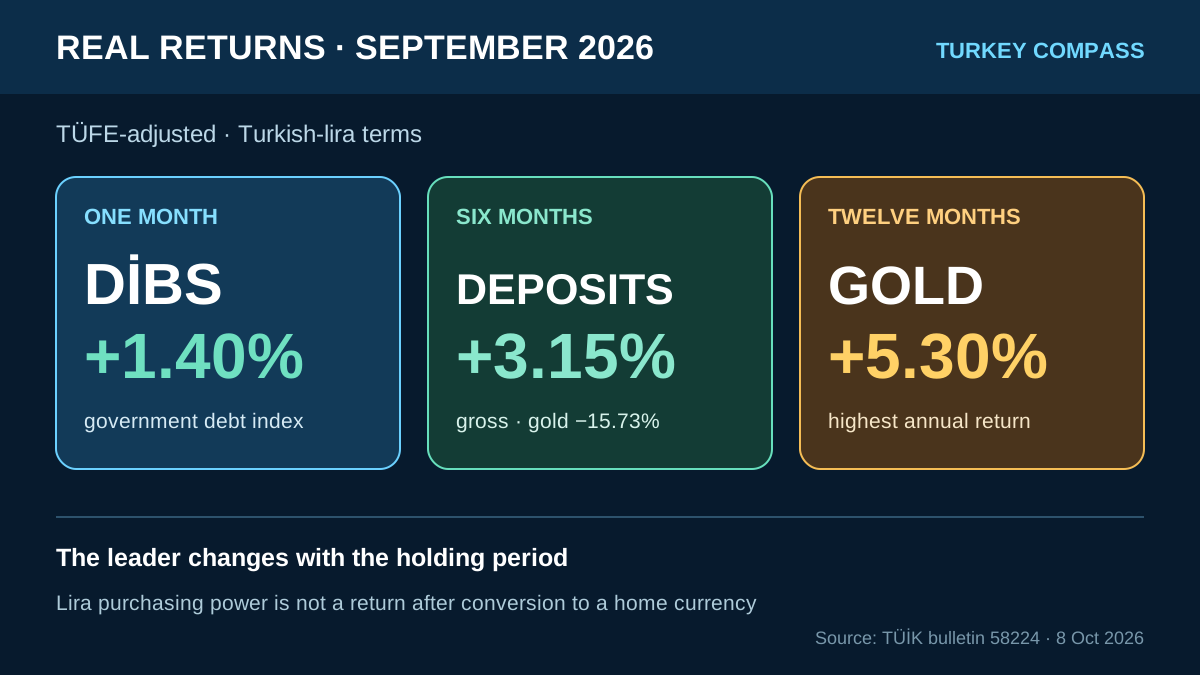
Turkey's government domestic debt securities, known as DİBS, produced the highest monthly real return in September 2026, according to TÜİK's release of 8 October. The return was 1.40% after consumer inflation and 1.18% after domestic producer inflation. The ranking changed with the holding period: gross deposit interest led the three- and six-month comparisons, while bullion gold remained the twelve-month leader. For an international saver, these are Turkish-lira index results—not a forecast, a retail quotation or a return measured after converting back into a home currency.
DİBS led September as equities and gold lost purchasing power
After consumer inflation, gross deposits returned 1.19% in September. The US dollar lost 0.22%, the euro 0.89%, bullion gold 2.02% and BIST 100 5.79%. Using domestic producer inflation, deposits gained 0.96%, while the dollar lost 0.44%, the euro 1.12%, gold 2.24% and BIST 100 6.01%. TÜİK uses monthly average series and broad indices, so an individual's execution price, coupon, maturity and transaction costs can differ.
Deposits led both the three- and six-month horizons
Gross deposit interest delivered the strongest three-month result: 4.11% after consumer inflation and 3.42% after producer inflation. BIST 100 was the weakest over that period, losing 9.29% and 9.90% respectively. Over six months, deposits again ranked first at 3.15% after consumer inflation and 1.60% after producer inflation, while bullion gold had the largest loss at 15.73% and 16.99%. The deposit series is gross; withholding tax, bank-specific pricing, maturity and early-withdrawal rules can reduce a customer's net result.
Gold still led the twelve-month comparison
For the year to September, bullion gold returned 5.30% after consumer inflation and 7.25% after producer inflation. DİBS remained positive at 3.93% and 5.85%, and gross deposits at 0.32% and 2.17%. After consumer inflation, BIST 100 lost 4.56%, the dollar 9.26% and the euro 10.97%; the producer-inflation-adjusted losses were 2.80%, 7.58% and 9.33%. A one-month loss for gold therefore coexisted with a positive full-year result because each horizon starts from a different price.
What DİBS means for a retail or foreign investor
DİBS is a category of Turkish Treasury bills and government bonds, not a single fixed-rate product. TÜİK uses the BIST-KYD DİBS All index, which reflects discounted and fixed-coupon securities across maturities. A buyer's return depends on the chosen bond, purchase price, coupon, remaining maturity, sale date, custody costs and tax treatment. Bond prices can fall when market yields rise, so the category should not be read as a guaranteed 1.40% monthly return available after the fact.
Lira real return is not a euro or dollar return
TÜİK compares lira-denominated values with Turkish consumer or producer inflation. That is useful for measuring purchasing power inside Turkey, but it does not show what a saver gained after exchanging euros, dollars, pounds, hryvnia or roubles into lira and later converting back. A sound personal comparison uses the actual holding period, net costs and taxes, the currency of future expenses, liquidity needs and loss tolerance. The bulletin is backward-looking statistical evidence, not individual investment advice.