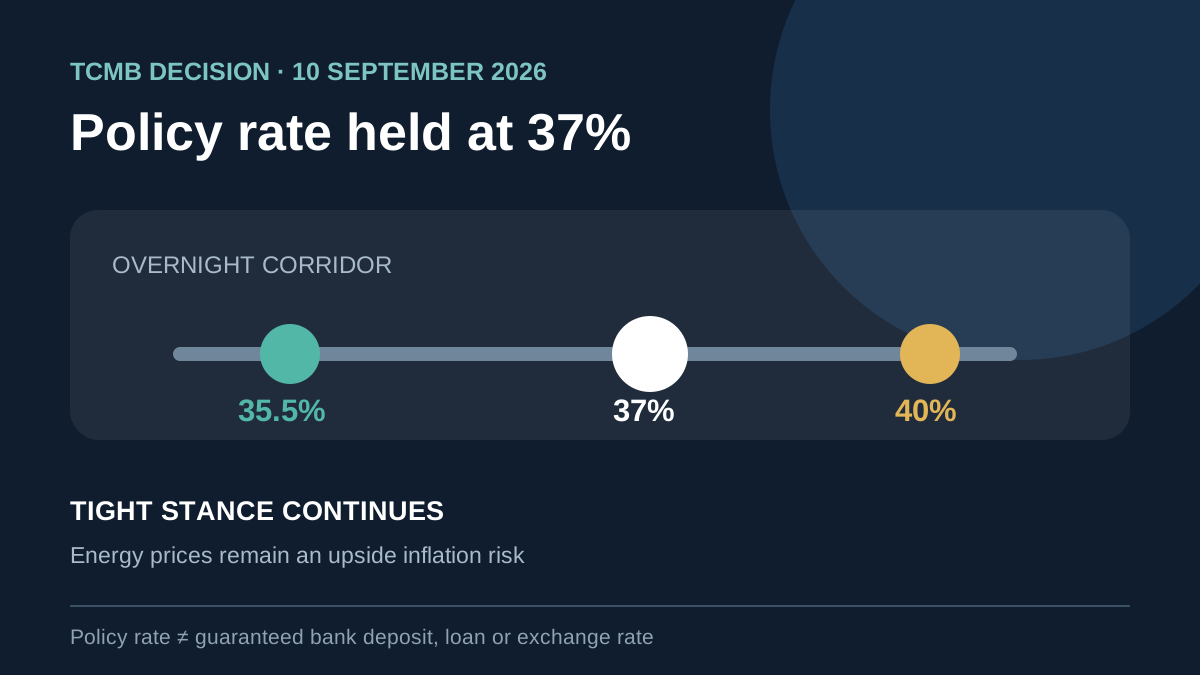
The Central Bank of the Republic of Turkey published the detailed summary of its 10 September meeting on 17 September 2026. The policy rate remained 37%, with overnight lending at 40% and borrowing at 35.5%. The new document adds a practical snapshot for savers and borrowers: average lira deposit rates were 44.4%, commercial loan rates 49.3% and housing-loan rates 41.9% in the week ending 4 September. These are dated market averages, not a rate available to every customer.
Mortgage rates moved differently from deposits
Compared with the week ending 24 July, the average lira deposit rate fell 255 basis points to 44.4% and the average commercial loan rate excluding overdrafts and credit cards fell 242 basis points to 49.3%. Housing-loan rates, however, rose 55 basis points to 41.9%. Consumer loans excluding overdrafts averaged 63.0%, while volatile vehicle-loan rates were 37.6%. The divergence shows why a policy-rate headline cannot substitute for an actual mortgage or deposit quote.
The 37% policy rate is still a central-bank instrument
The one-week repo rate remains 37%, the overnight lending rate 40% and the overnight borrowing rate 35.5%. Commercial banks add maturity, customer risk, funding cost, taxes, fees and margin. Compare effective annual cost or net return on the same date and terms; do not compare the policy rate directly with an advertised monthly mortgage rate.
Weak demand did not remove the inflation risk
The committee said second-quarter data showed a clearer weak trend in domestic demand, and early third-quarter indicators confirmed it. Consumer inflation was 31.51% in August. Goods inflation was around 26%, while services inflation remained close to 40%, illustrating why household bills can feel different from the headline rate.
Rent inflation slowed annually but rose 3.04% in August
The summary said monthly rent inflation increased to 3.04% with seasonal contract renewals, while annual rent inflation continued to slow and the seasonally adjusted trend became more visibly weaker. This is a national index signal, not a current asking rent for Istanbul, Antalya, Ankara or a specific property.
Energy and transport remain the upside channel
Brent crude averaged about USD 91 in August and USD 103 in the first ten days of September, according to the summary. Fuel pushed transport-service inflation higher, with air transport among the prominent items. The bank treated energy, supply-chain and freight uncertainty as an upside risk; it did not publish a lira, fuel-price or airfare forecast.
A checklist for savers, borrowers and property buyers
Request a dated written offer and record the term, net yield, tax, allocation fee, insurance, early-exit rule and total repayment. Foreign-currency investors should test lira returns against both inflation and exchange-rate scenarios. Property buyers should calculate the full financing cost and obtain a current bank approval: neither the 37% policy rate nor the 41.9% average housing-loan rate guarantees eligibility, a future rate or a property return.
TCMB — Interest Rate Press Release 2026-38, 10 September 2026 →