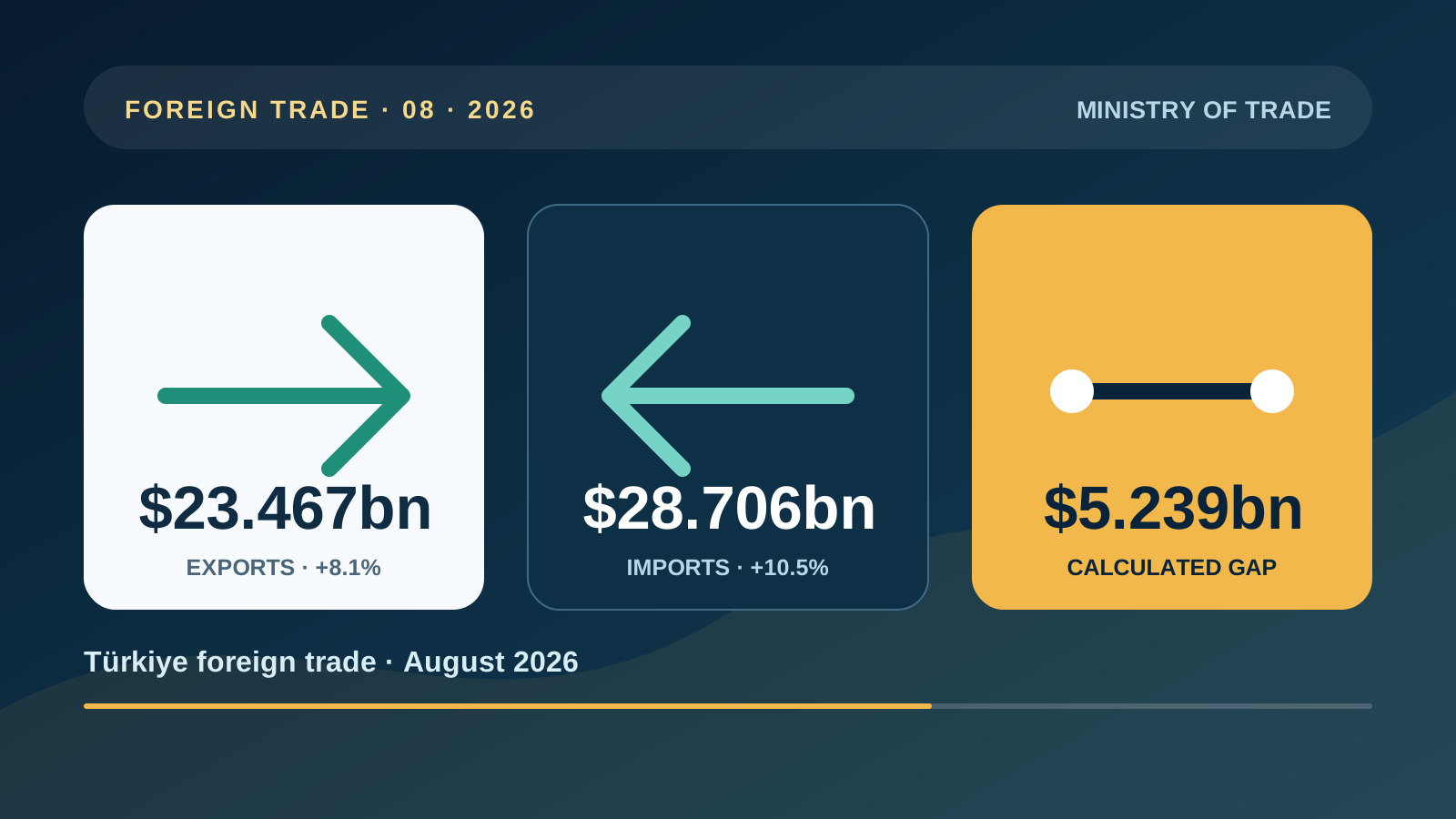
Turkey exported $23.467 billion of goods in August 2026, up 8.1% from a year earlier, while imports rose 10.5% to $28.706 billion, the Ministry of Trade reported on 3 September. The ministry's detailed table records a $5.240 billion goods deficit and an 81.8% export-to-import coverage ratio. Germany was the largest export destination and China the largest source of imports. For international investors and businesses, the signal is mixed: trade expanded, but the import bill grew faster. These are provisional, nominal US-dollar merchandise figures, not a full measure of the current account or a forecast for the lira, inflation or company profits.
The official August goods gap was $5.240 billion
The detailed bulletin reports exports of $23.467 billion, imports of $28.706 billion, a $5.240 billion deficit and an 81.8% coverage ratio. Subtracting the displayed rounded totals gives $5.239 billion; the $1 million difference reflects rounding of underlying values, not a conflict in the data. In practical terms, every $100 of imported goods was matched by about $81.80 of exports during the month.
Imports outpaced exports in the annual comparison
Exports were 8.1% higher than in August 2025, but imports increased by 10.5%. The faster import growth is why the goods balance did not improve in step with the export headline. Using the published growth rates to reconstruct last year's comparable values suggests exports of about $21.71 billion and imports of about $25.98 billion, although rounding means those estimates are approximate. The direction is more reliable than a decimal-level comparison: both sides grew, and inbound trade grew more quickly.
The eight-month deficit was about $65.8 billion
From January through August, exports totalled $185.006 billion, 4.0% above the same period of 2025. Imports reached $250.791 billion, an increase of 5.3%. The difference between those official cumulative totals is $65.785 billion, while exports covered about 73.8% of imports. This longer period reduces the influence of one unusual shipment, but it still reflects gross goods flows. Services, tourism receipts, investment income and financing belong elsewhere in the balance of payments.
A larger trade volume does not by itself mean stronger margins
Total trade in August reached $52.173 billion, 9.4% more than a year earlier. For logistics providers and companies paid per shipment, more volume can create opportunities. For manufacturers, retailers and importers, however, nominal growth can also reflect higher prices, exchange-rate effects or more expensive intermediate inputs. The release does not break the increase into price and quantity components and does not show company profitability. Investors should therefore compare it with sector production, producer prices, freight rates and corporate disclosures.
Germany led exports; intermediate goods dominated both flows
The detailed bulletin lists Germany as Turkey's largest August export market at $1.759 billion, followed by the United States at $1.734 billion and the United Kingdom at $1.201 billion. China led imports at $4.710 billion, ahead of Germany at $2.070 billion and the United States at $1.873 billion. Intermediate goods accounted for $13.154 billion of exports and $20.287 billion of imports, rising 19.7% and 14.5% respectively. The EU-27 bought $8.816 billion of Turkish goods and supplied $8.439 billion of imports. These headline tables still do not substitute for company-level customs-code, counterparty or sanctions checks.
The detailed August estimate is not a seasonally adjusted trend
The bulletin adds country groups, leading partners and broad economic-use categories, but the figures remain provisional. Comparing August's $5.240 billion deficit with July's $7.343 billion gap can provide context, yet the raw values are neither calendar- nor seasonally adjusted. Working days, seasonal trade and large energy or gold transactions can move a single month sharply. A durable conclusion still needs several observations and the final detailed series.
What companies should monitor next
Exporters should test whether order books and payment terms match the national growth rate rather than assuming that the headline applies to every sector. Importers should map foreign-currency exposure, inventory needs and the cost of intermediate goods, especially after August producer prices also accelerated. Investors can use Germany's export lead, China's import lead and the strong intermediate-goods growth as signals of market exposure, then compare them with detailed customs data and company disclosures. The defensible conclusion is narrow: merchandise trade expanded, but imports grew faster than exports and left a sizeable goods shortfall.