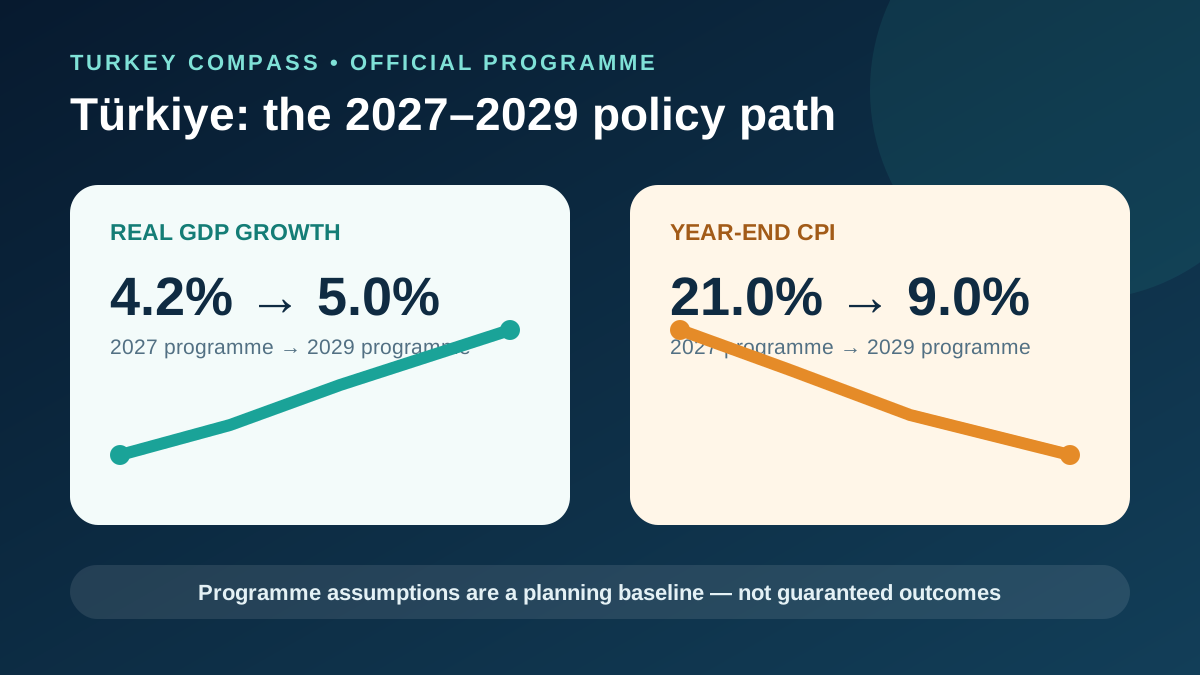
Turkey's Presidency of Strategy and Budget published the 2027–2029 Medium-Term Programme on 6 September, giving businesses and international investors a new official baseline for public policy and budget preparation. The document labels 2026 as an estimate and 2027–2029 as programme figures. It estimates real GDP growth at 3.3% and year-end consumer inflation at 28.4% for 2026, then sets growth at 4.2% and inflation at 21.0% for 2027. By 2029, the programme targets 5.0% growth and 9.0% inflation. Those numbers describe the government's planning path; they are neither a contractual promise nor a substitute for the Central Bank's forecast range, market expectations or project-level due diligence.
The official path combines faster growth with disinflation
The central table moves real GDP growth from an estimated 3.3% in 2026 to programme rates of 4.2% in 2027, 4.6% in 2028 and 5.0% in 2029. Year-end CPI is put at 28.4% for 2026 and then 21.0%, 13.5% and 9.0% across the three programme years. Per-capita income is projected to rise from $20,523 in 2026 to $24,842 in 2029. These variables interact, but the table does not guarantee that wages, rents, company revenue or an individual's purchasing power will follow the same trajectory.
A programme target is not the Central Bank's inflation forecast
The Medium-Term Programme is a government planning document used to frame policy, public finances and future budgets. The Central Bank publishes a separate Inflation Report with forecast ranges and risk analysis, while its market-participants survey records respondents' expectations. Calling the programme's 9.0% figure a guaranteed 2029 result, or presenting 28.4% as today's measured inflation rate, would be misleading. Investors should compare all three sources and note their publication dates, definitions and revision cycles before building a nominal-price or interest-rate scenario.
The external balance remains in deficit throughout the plan
The programme estimates a $47.5 billion current-account deficit in 2026, equal to 2.6% of GDP. It then projects deficits of $38.5 billion in 2027, $37.0 billion in 2028 and $35.5 billion in 2029, with the GDP ratio narrowing to 1.6% by the final year. Tourism revenue is programmed to increase from $65.0 billion in 2026 to $78.5 billion in 2029. A smaller deficit ratio would reduce one source of macroeconomic vulnerability, but it does not prescribe a lira exchange rate or remove global energy, financing and geopolitical risks.
Trade targets signal scale, not a sales guarantee
Goods exports are estimated at $282 billion for 2026 and programmed to reach $292 billion, $302.5 billion and $316 billion from 2027 through 2029. Imports are put at $387 billion in 2026 and rise to $426 billion by 2029. The plan also prioritises higher-value, technology-intensive, green and digital exports, stronger trade finance and more diversified markets. A foreign company should read these as policy direction. They do not confirm demand for a particular product, eligibility for support, customs treatment, payment security or the profitability of a Turkish subsidiary.
The energy assumptions deserve their own stress test
The baseline uses an average Brent crude assumption of $88 a barrel for 2026, falling to $76 in 2027, $72 in 2028 and $67 in 2029. Energy imports are estimated at $71 billion this year and projected to decline to $61 billion by 2029. Actual oil and gas prices can diverge sharply from a planning assumption. Importers, transport operators, hotels and manufacturers should therefore run higher-energy-cost cases instead of copying the programme's path directly into a cash-flow model.
What the labour targets may mean for operating plans
The official table estimates unemployment at 8.1% in 2026, declining to 8.0% in 2027, 7.8% in 2028 and 7.6% in 2029. Employment is programmed to rise from about 32.6 million people to 34.7 million. For an employer, lower national unemployment can imply tighter recruitment conditions in some occupations, but it says nothing about the availability, salary or work-permit status of a particular candidate. Labour costs, social-security contributions, city-level demand and sector skills remain separate inputs to any investment decision.
How an international investor should use the document
Treat the programme as a transparent government baseline for scenario analysis. Start with its growth, inflation, trade and energy assumptions, then add downside and upside cases using Central Bank reports, current TÜİK releases, audited company accounts and contract-level currency exposure. Recalculate financing at several interest rates and test revenue with slower disinflation. For real estate, compare nominal rent with maintenance, tax, vacancy and exit costs rather than assuming that national growth raises every asset. The defensible conclusion is that Turkey has published an ambitious disinflation-and-growth path; whether it is achieved must be tracked against later data and policy decisions.