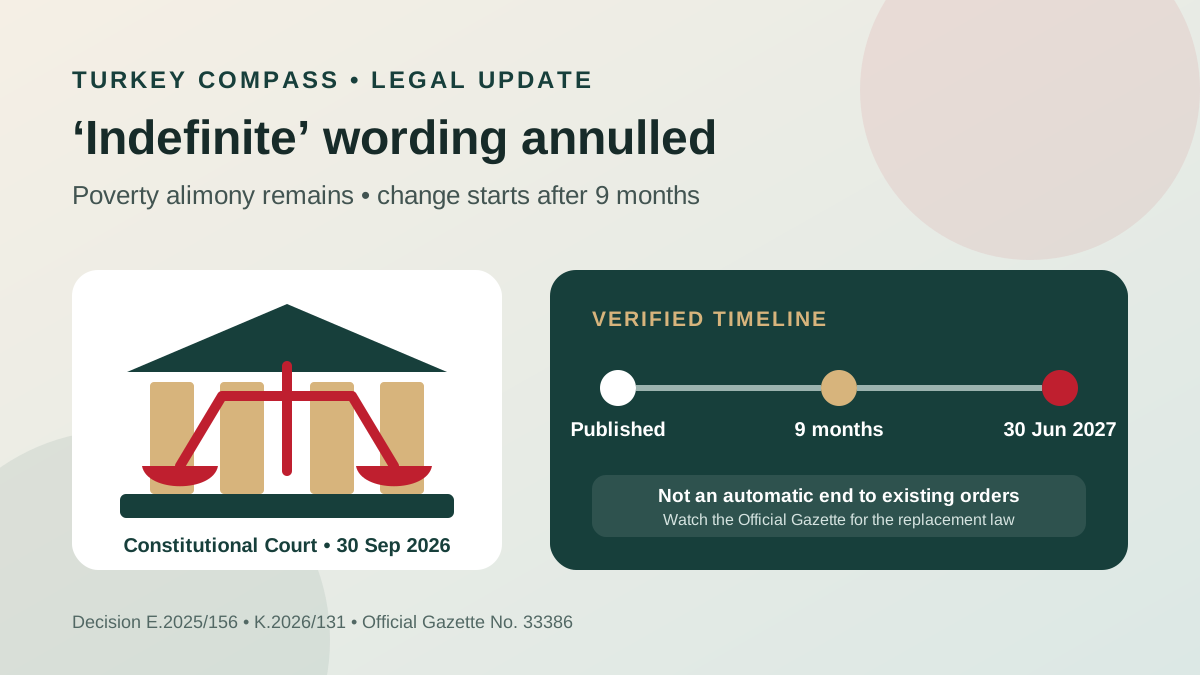
Turkey's Constitutional Court has annulled the words 'indefinitely' in Article 175(1) of the Turkish Civil Code, the provision governing poverty alimony after divorce. The decision was published in the Official Gazette on 30 September 2026. It does not abolish poverty alimony and it does not change payments overnight: the annulment takes effect nine months after publication, giving parliament time to design a clearer duration framework. For foreign residents and cross-border couples, the first question is whether Turkish law governs the divorce or support claim at all.
Exactly what the court annulled
The target was a narrow phrase in Article 175(1), not the whole article. The provision currently lets the spouse who would fall into poverty because of divorce, and whose fault is not more serious than the other spouse's, seek support in proportion to the payer's financial capacity 'indefinitely'. The court removed only those words. The eligibility test, the assessment of fault and financial capacity, and the separate Article 176 rules on lump-sum or periodic payment, adjustment and termination were not struck down by this judgment.
Why the Constitutional Court intervened
The majority found that the wording and settled court practice did not give judges a sufficiently predictable way to set duration. In practice, the Court observed, the phrase had been treated as mandatory, even though an earlier constitutional judgment had read it as not requiring lifetime support in every case. The majority said that tying a payer to an open-ended obligation without statutory criteria could upset the fair balance between former spouses' interests and affect the payer's material and personal well-being. Three judges dissented, stressing the protective function of need-based support.
The rule remains in force during the transition
The annulment is delayed for nine months from 30 September 2026. Until that period ends, the challenged wording remains part of the Code. The delay is important: the Court expressly said that immediate deletion would create a legal gap contrary to the public interest. Parliament can adopt a replacement before the deadline, potentially giving judges criteria for fixed, extendable or exceptional indefinite awards. Readers should therefore treat 30 June 2027 as a legislative checkpoint, not assume that one final model has already been enacted.
Existing payments do not automatically disappear
Publication of the decision is not an automatic cancellation notice for an existing court order. Constitutional annulment decisions are generally non-retroactive, and a final divorce judgment remains a judicial decision unless the law provides a route to alter it. Article 176 already identifies circumstances in which periodic support ends automatically or may be reduced, increased or lifted by a court. Whether a pending case, an appeal or an existing award is affected will depend on timing, the final replacement law and the procedural posture; stopping payment unilaterally can create enforcement exposure.
What the ruling means for foreign nationals
A foreign passport does not by itself answer which law applies. A divorce heard in Turkey may involve Turkish private-international-law rules, a foreign spouse's national law, questions of habitual connection, or recognition of a foreign judgment. The Constitutional Court ruling is directly relevant when Article 175 of the Turkish Civil Code governs the support claim. In a cross-border file, couples should separately identify jurisdiction, applicable law, service abroad, currency of payment and whether an order must be recognised or enforced in another country.
What has not changed
The ruling does not remove the possibility of support for a spouse who would otherwise fall into poverty, does not set a universal one-, five- or ten-year limit and does not rewrite the conditions for child maintenance. Poverty alimony between former spouses and maintenance for children are legally distinct. Nor did the Court decide the amount in any individual case. Income, assets, ability to work, health, age, duration of marriage, care responsibilities and the parties' conduct may remain important, but the legislature must decide the future statutory framework.
Documents to preserve before seeking advice
Anyone with a Turkish divorce or support file should keep the final judgment, proof of service and finality, payment records, enforcement notices, current income and asset evidence, health or disability records, and documents showing care responsibilities. Cross-border couples should add marriage and divorce certificates, citizenship records, foreign judgments, apostilles and certified translations. The official court decision and its publication date should be saved with the file. A lawyer can then assess the case against the transition date instead of working from social-media claims that alimony has already ended.
What to watch next
The decisive next development will be legislation, not commentary on the headline. A new text could define factors judges must weigh, create ordinary and exceptional durations, allow extensions where need continues, or preserve other safeguards. Parliament may also address transitional treatment for pending cases. Until an enacted text appears in the Official Gazette, there is no verified new duration table. Turkey Compass will treat claims such as 'all lifetime alimony is cancelled' or 'every old order ends in June' as unproven unless the final legislation says so.
Official Gazette — index of issue No. 33386, 30 September 2026 →
Official consolidated text — Turkish Civil Code No. 4721 →
Official consolidated text — Constitution of the Republic of Türkiye →