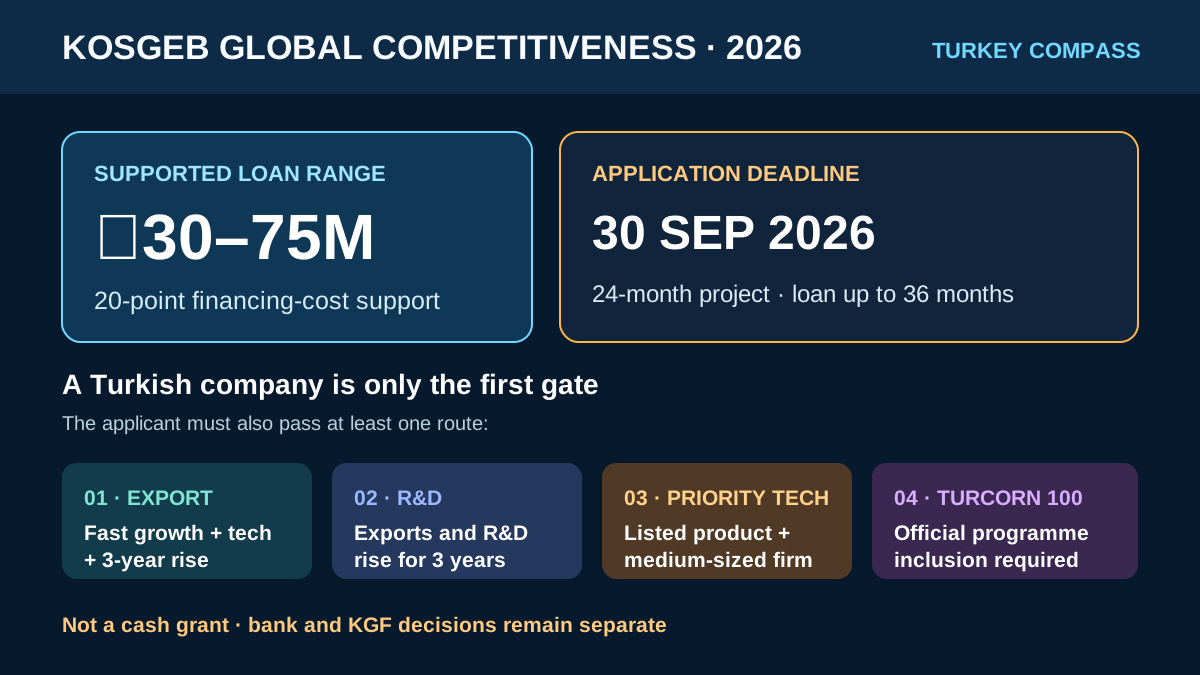
Turkey's Small and Medium Enterprises Development Organization, KOSGEB, opened the first 2026 application period for its Global Competitiveness Support Programme on 7 September. Applications close on 30 September 2026. The programme offers a loan range of ₺30 million to ₺75 million, with a 24-month project period and a maximum loan maturity of 36 months. Those headline numbers are substantial, but they do not describe an open grant for every SME. A business must meet KOSGEB's basic registration conditions and pass at least one of four demanding growth, export, R&D, priority-technology or Turcorn tests. That distinction is especially important for an international founder who has incorporated in Turkey but has not yet built the operating history required by the programme.
The application window is short and the finance is structured
KOSGEB says the application period began on 7 September and ends on 30 September 2026. The supported loan must be at least ₺30 million and no more than ₺75 million. Projects may run for 24 months, while the financial institution's loan maturity may extend to 36 months. The announcement describes a non-repayable financing-cost support of 20 points for loans obtained from financial institutions. This should not be read as KOSGEB paying 20% of the principal, cancelling the debt or fixing the applicant's final interest rate. The financing contract, bank pricing, repayment schedule and KOSGEB calculation all need to be checked in writing before a company commits.
A Turkish company and current KOSGEB declaration are only the first gate
The applicant must be active in the KOSGEB database, have an up-to-date İşletme Beyanı, or Enterprise Declaration, and operate as a real or legal person under the Turkish Commercial Code. These conditions define the administrative starting point; they do not make every registered company eligible. A newly formed subsidiary, a dormant company or a business created mainly to hold property will not qualify merely because it has a Turkish tax number or KOSGEB record. Before preparing a project file, founders should confirm the enterprise-size classification, activity code, declaration status and the financial and export data KOSGEB will use for the special eligibility test.
Route one requires fast growth, technology and rising exports
The first route is for a fast-growing enterprise operating in a medium-high or high-technology sector whose exports increased in each of the previous three years. Every element matters. Growth alone is insufficient, an isolated export jump is insufficient, and a company outside the specified technology intensity does not pass this route simply by selling abroad. Applicants should reconcile annual export values with customs and accounting records and confirm how KOSGEB defines the three-year comparison. A decline in one year may break the required continuous pattern even when the longer-term total has risen.
Route two links fast growth to both exports and R&D spending
A second route is available to a fast-growing enterprise whose exports and research-and-development expenditure both increased in each of the last three years. This creates two parallel evidence chains. A company needs more than an R&D narrative or a single development invoice: its financial records must support a year-by-year increase, and its export record must do the same. International groups should avoid assuming that expenditure or exports booked by a foreign parent can automatically be attributed to the Turkish applicant. The legal entity applying, the accounting treatment and the programme's data sources should align.
Two narrower routes cover priority technology and Turcorn 100
The third route concerns a medium-sized high-technology enterprise working on products included in the priority product list under Turkey's Technology-Oriented Industry Move Programme. The fourth covers businesses included in Turcorn 100, the national scale-up programme. These are specific statuses, not broad descriptions a company can award itself. Producing a sophisticated component does not prove that the product appears on the relevant priority list, and describing a start-up as a potential unicorn does not place it in Turcorn 100. The project team should retain the official decision, programme inclusion or list evidence supporting the route it selects.
Foreign ownership is not a separate shortcut or an announced ban
KOSGEB's announcement focuses on the Turkish enterprise and does not create a special application route based on the founder's nationality. A foreign-founded company should therefore assess the same company-level conditions: Turkish Commercial Code status, KOSGEB records, size, sector, growth, exports, R&D and programme inclusion. The notice also does not say that foreign shareholding by itself is disqualifying. The practical conclusion is narrower: incorporation in Turkey can provide the legal platform, but ownership nationality neither replaces the eligibility history nor guarantees acceptance. Any shareholder, work-permit or sector-licensing issue remains a separate legal check.
Eligible costs extend beyond machinery but remain project-linked
The official list includes machinery, equipment and moulds; software; personnel; and services such as training, consultancy, mentoring, certification, testing, analysis, marketing, design and intellectual-property work. Working capital and project-finance needs can also fall within the programme. This breadth does not turn every past or ordinary operating cost into an eligible expense. The expenditure must fit the approved competitiveness project, timing and documentation rules. Companies should map each budget line to a project output, supplier evidence and payment record, and confirm whether tax, foreign-currency pricing, related-party procurement or imported equipment changes the eligible amount.
Bank credit and KGF guarantees remain separate decisions
KOSGEB says loans may be obtained from financial institutions and that a Credit Guarantee Fund, KGF, guarantee can be used. Neither statement promises credit approval or an automatic guarantee. A bank will still assess cash flow, leverage, collateral and repayment capacity, while KGF applies its own guarantee rules. The 20-point support relates to financing cost, not a waiver of principal or default risk. A prudent applicant should obtain a term sheet, model repayments without assuming the maximum support, confirm when support is paid, and submit well before 30 September so missing KOSGEB, bank or guarantee documents can be corrected.