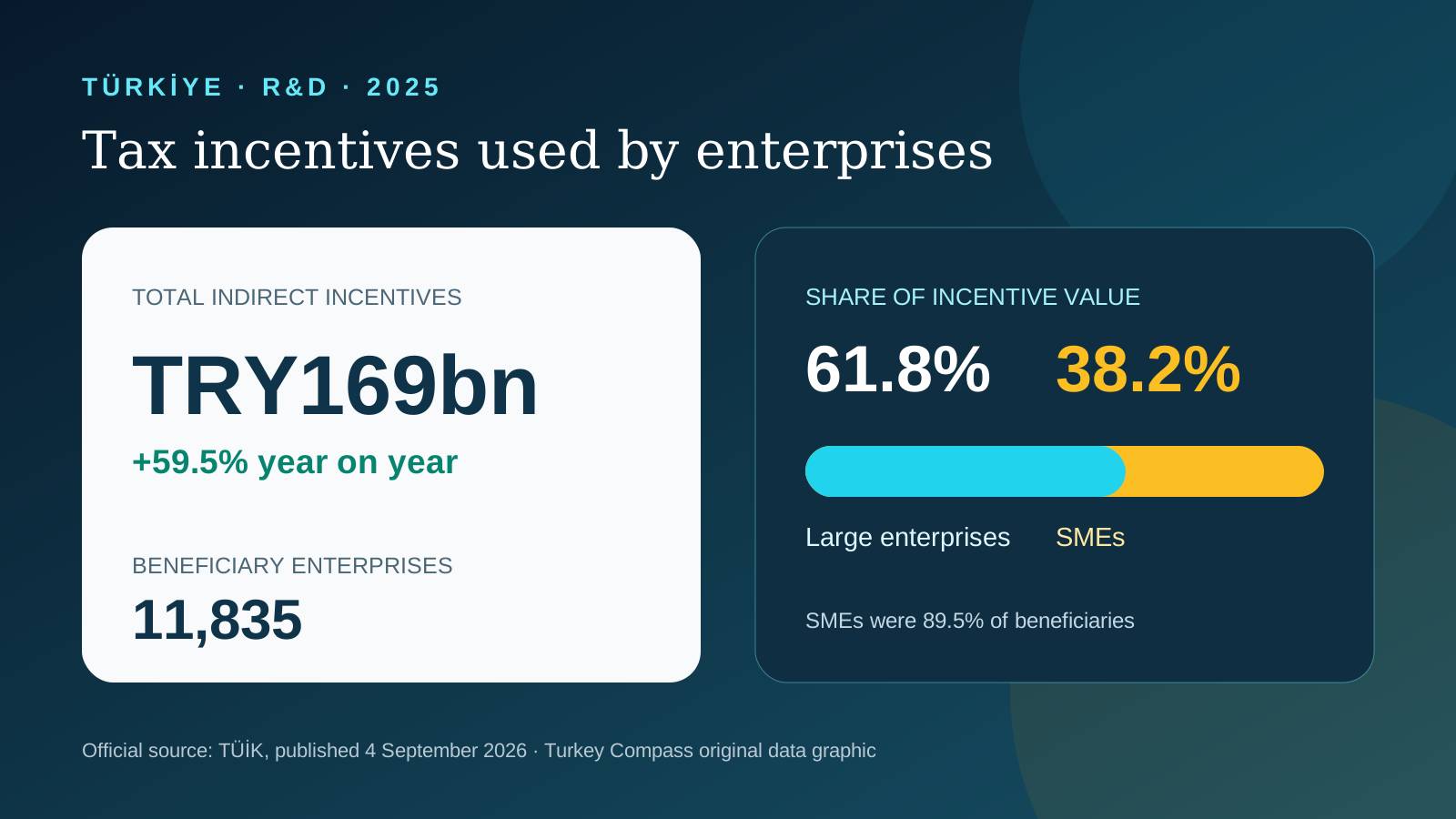
Turkey provided TRY169.033 billion of indirect tax incentives for research and development in 2025, 59.5% more than the TRY105.977 billion recorded in 2024, TÜİK reported on 4 September 2026. A total of 11,835 enterprises benefited. Information and communication companies formed the largest beneficiary group, while manufacturing dominated support under the separate R&D and design law. The headline is relevant to international technology and industrial investors, but it describes tax relief already used—not a new cash fund, an automatic entitlement or a promise that the same support will be available to every new company.
The total rose 59.5%, but it is a nominal lira comparison
Indirect R&D incentives increased by TRY63.056 billion between 2024 and 2025. The annual rate is calculated in current Turkish lira, so it does not measure the real increase after inflation and should not be converted directly into a dollar investment figure. TÜİK's release is retrospective: it records tax advantages used through the relevant declarations and legislation during 2025. It is not a 2026 budget allocation or a forecast of future support.
Payroll withholding and corporate tax drove the benefit
Income-tax withholding incentives accounted for TRY86.105 billion, or 50.9% of the total. Corporate-tax support reached TRY81.063 billion; personal income-tax relief was TRY1.725 billion and VAT support TRY141 million. The mix shows why R&D staffing and taxable business activity matter to the system. These are tax mechanisms rather than unrestricted grants: a company must have qualifying activity, documentation and a tax position to use the relevant relief.
Information and communication supplied half the beneficiary base
Of the 11,835 enterprises, 6,098 operated mainly in information and communication, 2,421 in manufacturing and 1,627 in professional, scientific and technical activities. This is a count of beneficiary enterprises, not their share of the incentive value, employment or exports. Investors should not infer that every software company in Turkey uses an incentive or that the programme alone explains the sector's growth.
Two legal routes produced different sector profiles
Under Law No. 4691 for Technology Development Zones, income- and corporate-tax R&D incentives totalled TRY43.227 billion; 71.2% was associated with information and communication and 14.5% with manufacturing. Under Law No. 5746 on R&D and design activities, the comparable total was TRY39.561 billion; manufacturing accounted for 72.9%, information and communication 14.7%, and finance and insurance 4.1%. The figures show distinct patterns, not a free choice of whichever regime produces the largest benefit.
Three quarters of income- and corporate-tax beneficiaries used the technopark route
Among 7,087 enterprises receiving income- or corporate-tax R&D support, 5,321 were covered by Law No. 4691 and 1,766 by Law No. 5746. That is a 75.1% versus 24.9% split by enterprise count. Eligibility depends on the activity, location, project and statutory conditions. A registered address in a technology zone does not by itself prove that every employee, invoice or revenue line qualifies.
SMEs dominated the count, while large firms dominated the money
SMEs represented 89.5% of the 11,835 beneficiary enterprises but received 38.2% of total indirect R&D incentives. Large enterprises were only 10.5% of the beneficiary count and received 61.8% of the amount. SMEs obtained TRY64.596 billion: 61.1% went to medium-sized firms, 32.1% to small firms and 6.8% to micro enterprises. The distribution is a reminder to compare access by value as well as by company count.
What a foreign investor should verify
Before placing a laboratory, software team or design centre in Turkey, identify whether the proposed work is genuinely eligible, whether a technology-zone structure or the R&D and design framework fits, and how payroll, intellectual property, transfer pricing and corporate tax interact. Request a written eligibility analysis from a licensed Turkish adviser and model the business both with and without incentives. The defensible conclusion is that Turkey has a large R&D tax-support system with strong technology and manufacturing participation; the bulletin is not an approval letter or investment recommendation.