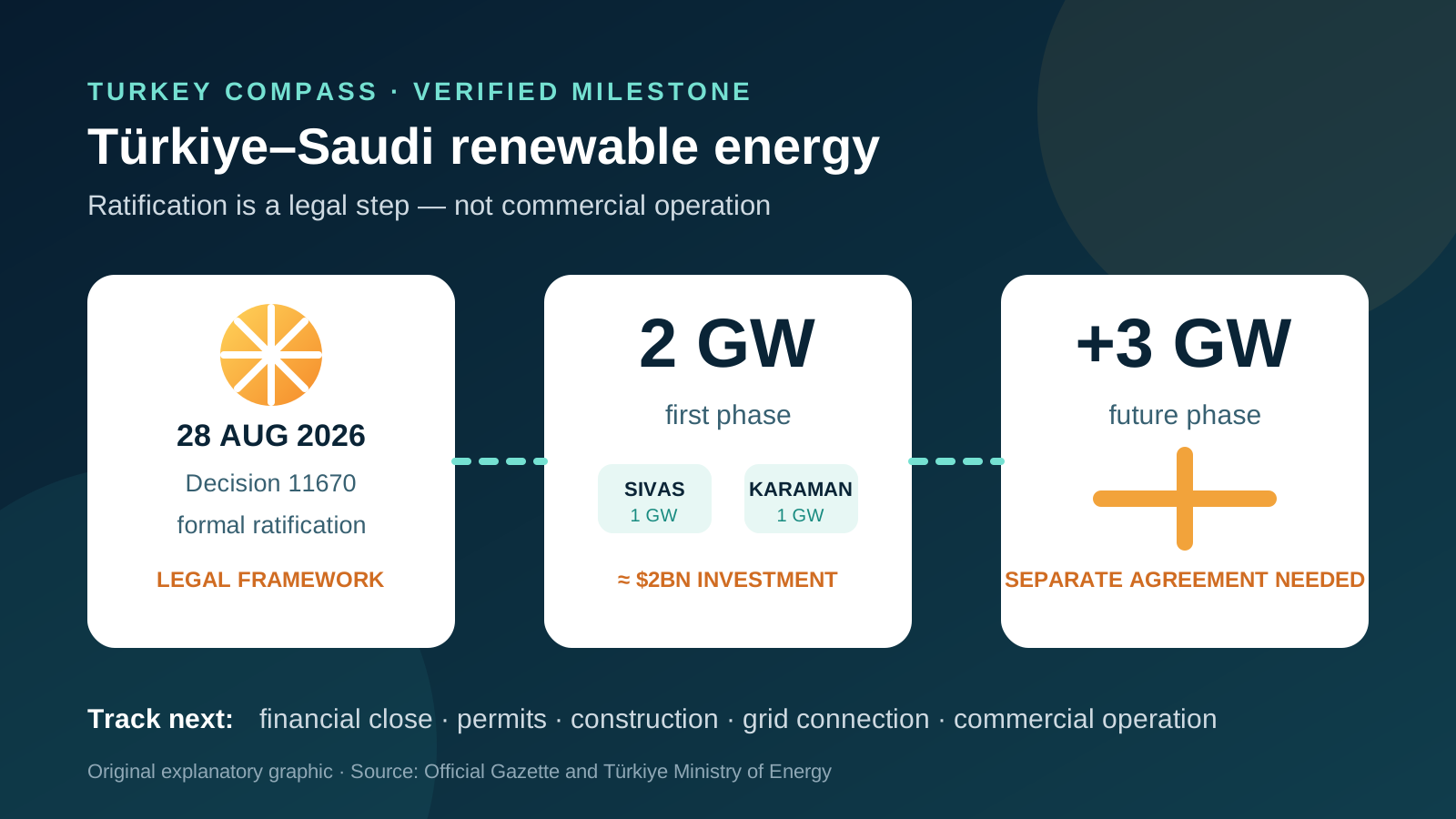
Turkey formally approved its intergovernmental renewable-energy agreement with Saudi Arabia through Presidential Decision 11670, published on 28 August 2026. The legal step matters for investors because it confirms state-level backing for a programme that had already moved into commercial documentation. It should not be reported as if two power stations were announced for the first time today. The Energy Ministry said in February that the first phase consists of two 1,000-megawatt solar plants in Sivas and Karaman Taşeli, representing about $2 billion of investment. The correct investor question is therefore not whether a new project suddenly appeared, but what formal ratification adds to an implementation chain that still requires construction, financing and delivery.
What was approved today
The Official Gazette publishes the approval of the government-to-government agreement signed by Turkey and Saudi Arabia. Ratification gives the interstate framework formal domestic legal effect and strengthens the policy foundation beneath the project agreements. It does not by itself certify that financing has closed, land works have finished, equipment has been ordered or either plant has begun producing electricity. International investors should separate four milestones: the interstate agreement, project and power-purchase documentation, financial close, and commercial operation. Today concerns the first layer. The Energy Ministry had already announced the investment and electricity-purchase agreements with ACWA in February, so the ratification is a legal milestone rather than a second project launch.
The first phase is 2 GW, not the full 5 GW vision
The documented first phase comprises a 1,000 MW solar plant in Sivas and another 1,000 MW plant in Karaman Taşeli. The ministry valued the pair at about $2 billion and said they could supply electricity equivalent to the needs of roughly 2.1 million households. Officials have discussed a wider 5,000 MW programme, with a later 3,000 MW phase potentially combining additional solar and wind capacity. That larger number must not be treated as fully contracted and under construction today. The ministry said in August that it aimed to conclude the additional phase around the Antalya climate conference, which confirms that the extra 3 GW remains a later implementation step.
Why the power-price structure attracts investor attention
The ministry described long-term electricity prices of about 2.35 euro cents per kilowatt-hour for Sivas and 1.99 euro cents for Karaman Taşeli, with the core fixed-price period extending for 25 years. It also described a five-year incentive mechanism and a total purchase horizon of 30 years. Those figures make the projects relevant to project-finance lenders, equipment suppliers and large electricity consumers watching Turkey's cost base. They are contractual headline terms, not a promise that every Turkish consumer tariff will fall by the same amount. Retail bills also reflect networks, taxes, market balancing, generation mix and regulated decisions. A power-purchase price cannot be copied directly into a household bill forecast.
Local content creates a Turkish supply-chain angle
The government has said the first two plants should reach at least 50% local content. That condition can create opportunities for Turkish manufacturers, engineering firms, construction contractors, logistics providers and service companies, but it does not guarantee contracts to any particular supplier. Investors should examine how local-content compliance is measured, which equipment categories qualify, and whether procurement timetables align with manufacturing capacity. The state-level agreement may improve visibility, yet bankability will still depend on detailed contracts, permits, grid connection, construction performance and financing. A supplier announcement should therefore be verified against an awarded contract rather than inferred from the 50% target alone.
The timetable has already evolved
An early February ministry statement referred to foundations in 2027 and completion across 2027–2029. A later official update on 20 February said foundations were expected in 2026 and commercial operation for both plants at the beginning of 2028. The later statement is the more current public timetable, but today's ratification decision does not publish a revised construction schedule. Investors should monitor project-company notices, permits, grid milestones and financing announcements before treating any date as guaranteed. Large energy projects can move because of engineering, procurement, land, transmission and lender conditions; formal approval reduces one category of uncertainty but does not eliminate execution risk.
What foreign investors should verify next
The next evidence points are financial close, final engineering and procurement awards, construction notices, connection arrangements, environmental and land approvals, and any official documentation for the additional 3 GW. Equity and debt investors should also test currency, indexation, termination, force-majeure and sovereign-support provisions in the actual contracts rather than relying on headline summaries. Industrial investors can model potential regional activity in Sivas and Karaman, but should avoid counting future output as operating capacity until commissioning. The practical conclusion is positive but disciplined: Decision 11670 strengthens the legal foundation of a large Saudi-backed renewable programme, while project completion and the wider 5 GW ambition still depend on subsequent documented milestones.