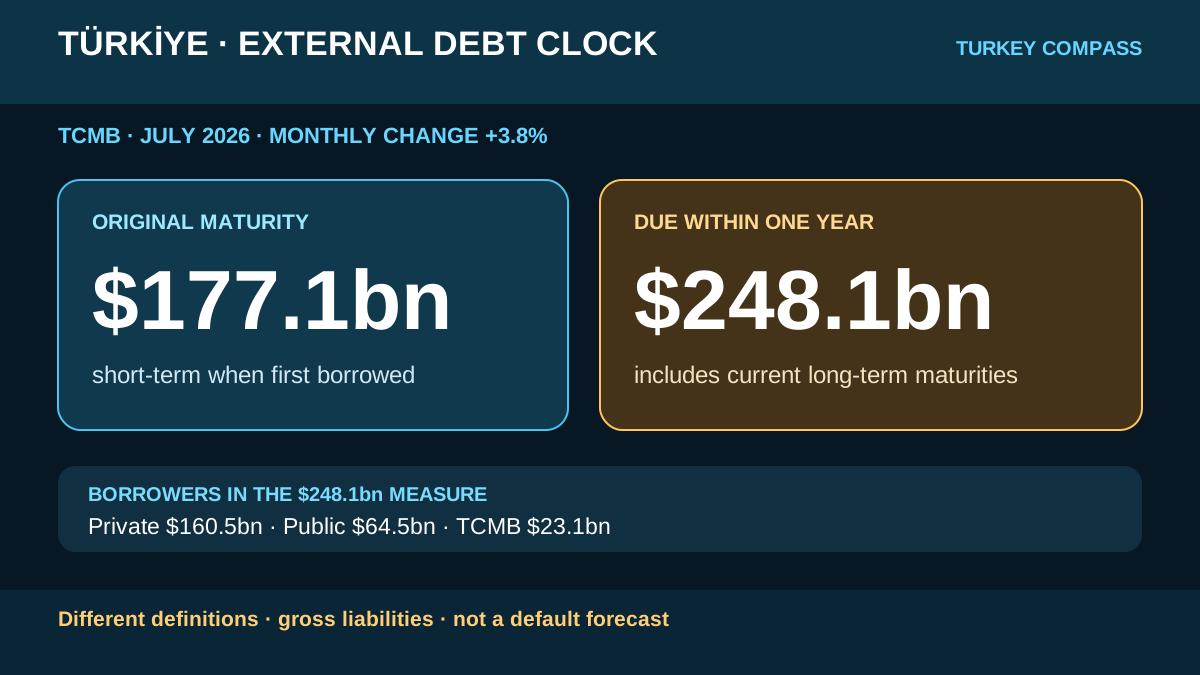
Türkiye's short-term external debt stock reached $177.1 billion at the end of July 2026, up 3.8% from June, according to the Central Bank of the Republic of Türkiye. A broader remaining-maturity measure — all external liabilities due within one year, including the current portion of longer-term debt — stood at $248.1 billion. International investors should keep those definitions separate: the figures describe the timing and composition of liabilities, not an official forecast of default, exchange rates or refinancing costs.
Banks and other sectors both added to the monthly increase
Banks' short-term external debt rose 4.3% in July to $77.8 billion. Within that total, short-term foreign-currency loans from abroad increased 23.5% to $9.8 billion. The short-term debt of other sectors rose 3.6% to $74.7 billion, including $65.1 billion of trade-credit liabilities and $9.7 billion of cash loans. These categories track different borrowers and instruments and should not be added again to the published total.
$177.1bn and $248.1bn are not competing totals
The $177.1 billion stock is classified by the debt's original maturity. The $248.1 billion remaining-maturity figure asks a different question: how much external debt, including longer-term borrowing, is scheduled to mature within the next year. The latter included $64.5 billion for the public sector, $23.1 billion for the TCMB and $160.5 billion for the private sector. It is a gross maturity schedule, not the government's budget deficit and not a net financing gap after assets, reserves or rollovers.
Currency composition matters for balance-sheet risk
The original-maturity stock was 34.3% in US dollars, 26.5% in euros, 26.0% in Turkish lira and 13.2% in other currencies. Currency denomination affects who carries exchange-rate risk, but it does not reveal hedges, export revenues or matching foreign-currency assets. A lira depreciation therefore cannot be applied mechanically to the whole $177.1 billion figure.
What foreign investors should monitor next
The most useful follow-up indicators are banks' external borrowing, corporate trade credit, international reserves, deposit behaviour, the current account and actual rollover ratios. Funding conditions can tighten even when debt is rolled over, while a high maturity amount can be managed if borrowers retain market access and adequate liquidity. One monthly release cannot establish either conclusion on its own.
What the data do not say about property or deposits
The release does not predict the lira, bank-deposit safety, mortgage pricing or property values. A buyer or business should test cash flows under several exchange-rate and interest-rate scenarios, check the specific bank and counterparty, and avoid treating a national gross debt statistic as a guarantee of either crisis or stability. The next monthly dataset may also revise earlier observations.
TCMB — Monthly Developments of Short-Term External Debt Statistics, July 2026 →