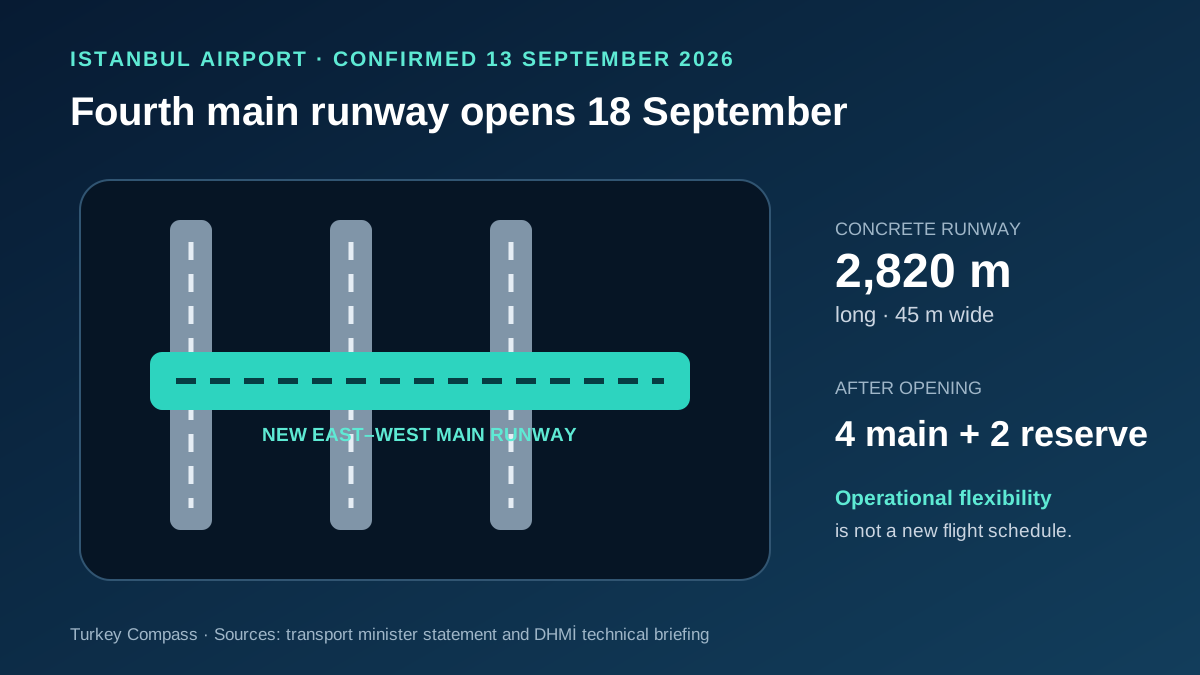
Istanbul Airport is scheduled to bring its fourth main runway into service on Friday, 18 September 2026, Transport and Infrastructure Minister Abdulkadir Uraloğlu said in a written statement published on 13 September. The 2,820-metre concrete runway will be the airport's first aligned east–west, adding a different operating direction to the existing north–south infrastructure. That matters for resilience and ground movement at Türkiye's largest international hub. It does not, by itself, create a new route, change a passenger's terminal or guarantee that a booked flight will depart earlier.
What is opening on 18 September
The new strip is described as the airport's fourth main runway. It is 2,820 metres long and 45 metres wide and sits on an east–west axis. The airport currently operates with three main and two reserve runways, all aligned broadly north–south. Once the new main runway enters service, the physical total will be six: four main and two reserve runways. Counting every strip as an independently usable commercial runway would be misleading, because the ministry distinguishes main from reserve infrastructure and operating combinations depend on air-traffic procedures.
Why the east–west direction matters
A crosswind can affect which runway direction is operationally preferable. The minister said the new alignment should give controllers and airport operators more options in varying weather and support safer operations in crosswind conditions. It is also positioned near hangar areas, which is expected to help general-aviation movements operate more independently. These are system-level benefits: the statement does not promise that weather disruption will disappear or that every arrival will use the new runway.
Possible effect on taxi and airborne time
The official expectation is shorter taxiing and less time in the air for some domestic and eastbound flights, together with fuel and time savings. Whether an individual service benefits will depend on its stand, traffic flow, assigned runway, wind and air-traffic-control sequence. Passengers should therefore treat shorter taxi times as an operational objective, not a published minimum connection time or a guaranteed reduction in the duration shown on a ticket.
No route or schedule change has been announced
The runway opening is an infrastructure event, not an airline network announcement. The minister's statement names no new destination, carrier, frequency or ticket sale. Travellers from Europe, Russia, Ukraine or Central Asia should continue to verify the operating airline, flight number and date-specific timetable through the airline or airport. A runway can create room for future capacity, but only carriers and slot decisions determine whether a particular city gains service.
Connections at IST still require the normal buffer
Nothing in the announcement changes passport control, security, baggage reclaim, terminal walking distances or the conditions for a self-transfer. Istanbul Airport remains a very large single-terminal complex, and a remote stand or gate change can still add time. Use the minimum connection time displayed for the exact itinerary, keep documents and boarding information accessible, and allow a wider margin when tickets are separate or checked baggage must be collected and rechecked.
The runway does not change the IST–SAW distinction
Istanbul Airport uses the code IST; Sabiha Gökçen on the Asian side uses SAW. The new runway belongs to IST and does not make a transfer between the two airports an airside connection. A change of airport still requires a journey across Istanbul, entry formalities where applicable and enough time for road conditions. Check both airport codes before payment, especially when a search engine combines separately issued tickets.
How the announcement fits the airport's wider plan
DHMİ's 1 August technical briefing said the runway was intended to support operational capacity, shorter taxiing and the longer-term goal of four-runway operations. The 13 September statement adds the concrete service date. The airport already introduced triple independent parallel runway operations in April 2025, according to the minister. The new east–west strip broadens the layout, but certification, traffic management and airline use remain operational matters rather than passenger entitlements.
Turkey Compass assessment
The confirmed news is precise: a 2,820-by-45-metre fourth main runway is scheduled to open at Istanbul Airport on 18 September, bringing the site to four main and two reserve runways. The plausible benefit is greater flexibility, particularly for eastbound, domestic, general-aviation and crosswind operations. The announcement does not confirm extra flights, lower fares, shorter queues or a new connection standard. Travellers should expect infrastructure improvement while continuing to plan from the timetable and conditions attached to their own booking.
DHMİ — official technical briefing on the fourth main runway, 1 August 2026 →