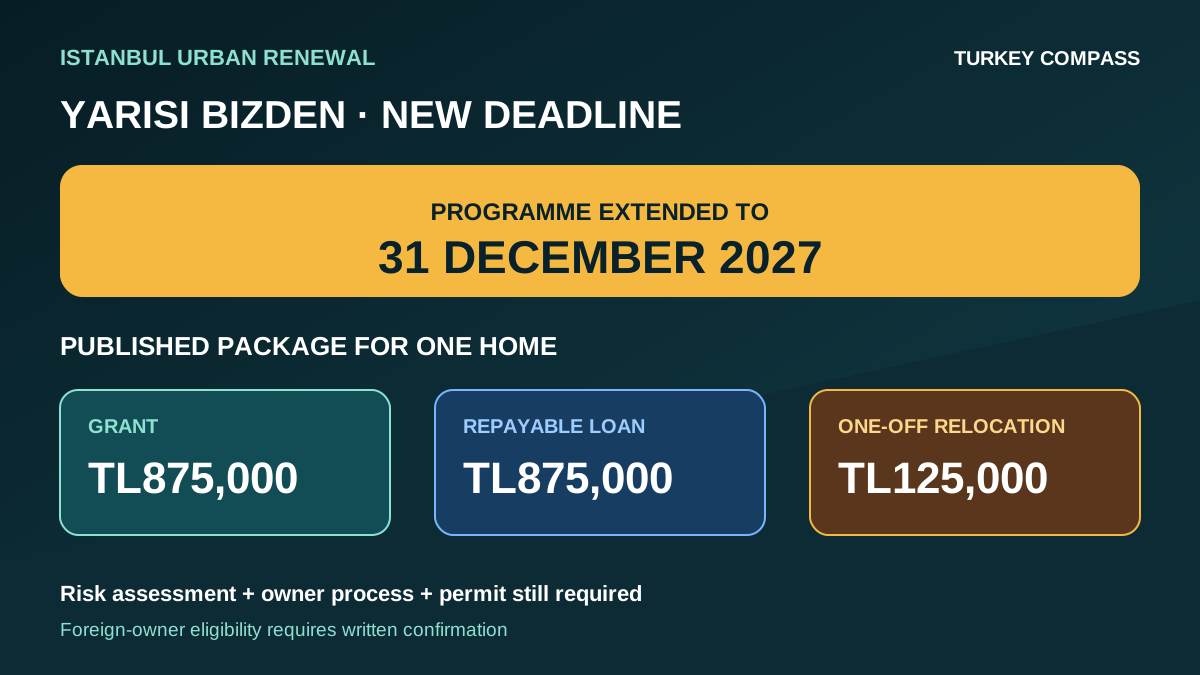
Turkey has extended Istanbul's Yarısı Bizden urban-renewal programme to 31 December 2027. President Recep Tayyip Erdoğan announced the new date after the Cabinet meeting on 7 September 2026; the official transcript was published by the Directorate of Communications. The change gives owners of risky buildings another year beyond the previously planned end of 2026, but it does not remove the technical, ownership and permit steps required for reconstruction. Current Ministry guidance describes support for one home as TL875,000 grant, TL875,000 loan and a one-off TL125,000 evacuation or relocation payment. The headline total of TL1.875 million can therefore be misleading if presented as money paid freely to an owner: construction instalments are transferred to the contractor on behalf of rights holders, the loan is repayable, and the relocation component is governed separately. Foreign owners should also note that the extension speech does not establish a nationality rule. A title deed or residence permit should not be treated as proof of eligibility without written confirmation from the competent authority.
What changed on 7 September
The confirmed policy change is the end date. The official statement says a programme that had been expected to finish at the end of 2026 will continue through 31 December 2027. It also reports that 108,881 independent units have completed transformation and work has begun for 435,683 units. Those figures describe programme progress, not a new allocation to each applicant. The statement does not say that existing applications are automatically approved, that incomplete buildings receive an amnesty, or that the support amounts rise with the extension.
A home package contains three different forms of support
For contractor-led, building-based transformation, the Ministry's campaign page lists TL875,000 as a grant and TL875,000 as a loan for one home. A further TL125,000 is available once for evacuation or moving, producing the widely quoted TL1.875 million total. These parts should not be added together as if they were one non-repayable cheque. If a tenant occupies the unit, current guidance says the relocation payment goes to the tenant; otherwise it goes to the owner. The construction grant and loan follow the approved project and payment procedure.
Business premises and additional units follow different limits
The published building-based terms provide TL437,500 grant and TL437,500 loan for one workplace, plus the TL125,000 relocation support, for a stated total of TL1 million. After support for the first home, each additional home is described as eligible for a TL1.75 million loan rather than another grant; after the first workplace package, each additional workplace may receive a TL875,000 loan. A person with several deeds should therefore calculate each independent unit separately and confirm which unit is treated as the first supported property before signing a contractor agreement.
The construction money is staged, not paid upfront to the owner
In the building-based model, Ministry guidance says payments are made directly to the contractor on behalf of rights holders. The schedule is 30% when work starts, 30% when the structural frame is completed, 30% at the plaster stage and 10% after the occupancy permit is obtained. This arrangement is intended to connect public funding with construction progress. Owners still need a contract that defines specifications, delays, guarantees, defects and the treatment of cost overruns. The programme label is not a substitute for checking the contractor's authority, record and financial capacity.
Risk assessment and a buildable project still come first
The programme is for risky buildings in Istanbul's 39 districts. Risk status is established through a Ministry-licensed institution; owners then need the required building decision, a project that complies with planning rules, a permit and the rights-holder process. Current guidance says the new project, excluding parking and shelter areas, cannot exceed one and a half times the size of the old building. The extension creates more time but does not guarantee that the existing floor area, every informal addition or an owner's preferred plan can be rebuilt. Title annotations, mortgages and municipal constraints require parcel-specific review.
Loan repayment is delayed, not cancelled
The campaign guidance states that repayment begins two years after the building permit and can run for up to ten years. No interest is applied in the first repayment year; in later years, the outstanding debt is updated by half of the consumer-price inflation rate. It also says income and credit-score tests are not used for the rights-holder loan. These points do not make the credit free: inflation-linked updates, timing, multiple supported units and household cash flow can materially change the total burden. Ask for the individual repayment table before committing to a construction budget.
Foreign-owner eligibility remains a point to verify
The presidential extension refers to Istanbul residents and citizens, while the Ministry's general guidance speaks broadly about owners of risky properties. Neither the 7 September transcript nor the campaign summary opened in this review provides a clear, current clause confirming how a non-Turkish title holder is treated. Foreign owners should request a written answer from the Istanbul Urban Transformation Directorate or the relevant district municipality, using the exact title record and rights-holder structure. A residence permit, Turkish company or property purchase made for citizenship purposes does not by itself prove access to this separate support scheme.
Do not confuse this extension with the TOKİ rental application
The Cabinet statement also announced that applications for 15,000 planned social-rental homes in Istanbul would begin on 14 September, with the first draw covering 1,000 units. That is a separate programme for prospective tenants. Yarısı Bizden concerns the transformation of an existing risky building and requires property, project and rights-holder procedures; it is not a rental draw. Advertisements that merge the two announcements, promise a new apartment merely for applying, or request a reservation fee are not supported by the official text.
A practical owner checklist before spending money
Verify the building's risk record through a licensed institution, obtain the current zoning status, review the title register and confirm the decision threshold for the owners. Ask the municipality which milestone must be completed by 31 December 2027 once the updated implementation notice is available. Compare contractor offers on the same technical specification, record every public-support instalment in the contract and obtain independent legal and engineering review before signing. Use official government pages and the district authority; do not pay an intermediary who claims to sell guaranteed programme approval.