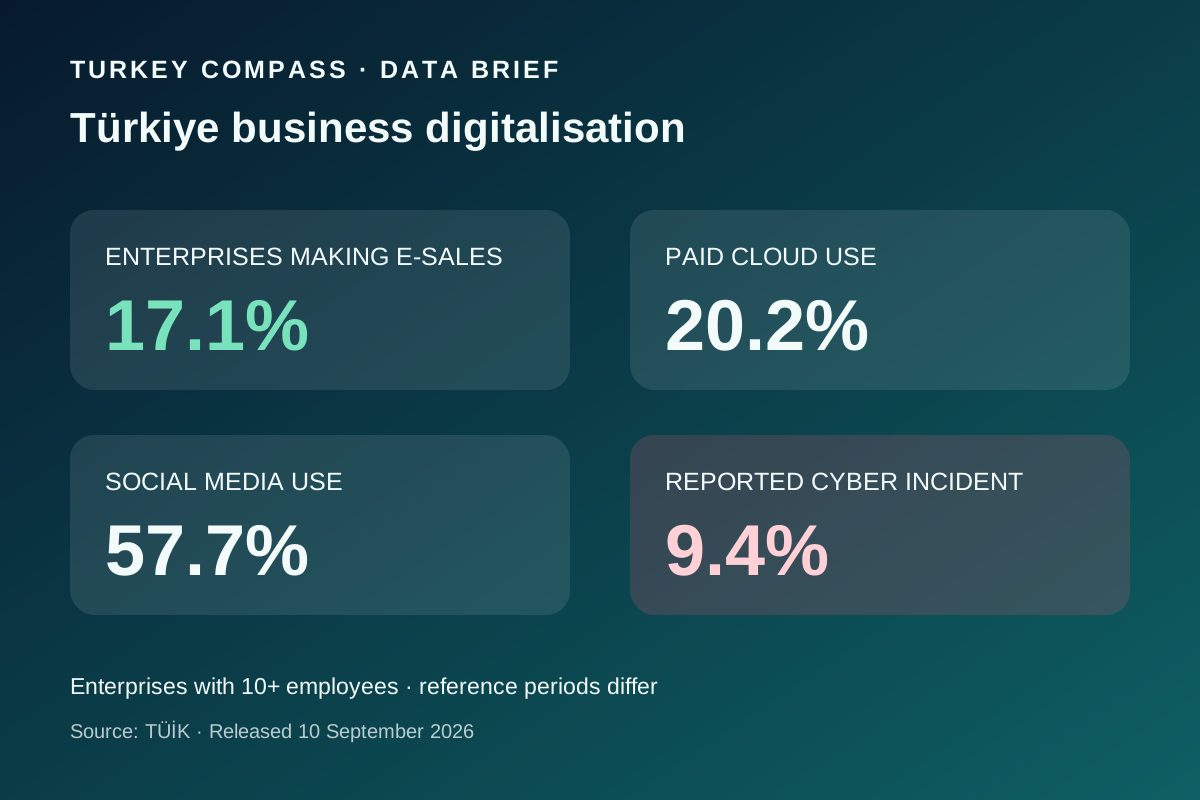
Turkey's enterprise technology survey points to faster online selling but uneven digital infrastructure. TÜİK reported on 10 September 2026 that 17.1% of enterprises made sales online or through electronic data interchange in 2025, up from 13.6% in 2024. In 2026, 20.2% used paid cloud services and 57.7% used social media. The survey covers enterprises with at least 10 employees, so it must not be presented as a census of every Turkish microbusiness. For international investors, it highlights both market-entry channels and operational risks.
E-sales rose, but the metric is participation rather than revenue
The share of enterprises making internet or EDI sales increased to 17.1% in 2025. Large enterprises were more active at 29.7%, compared with 18.3% for firms with 50–249 employees and 16.4% for those with 10–49. This does not mean that 17.1% of total business revenue came from online sales, nor does it measure consumer spending. It shows how many covered enterprises used an electronic sales channel at least once during the reference year.
Hospitality combined high e-sales with low paid-cloud use
Accommodation and food services had the highest e-sales participation at 43.3% in 2025, ahead of publishing and content activities at 25.4% and wholesale and retail at 23.7%. Yet only 12.6% of hospitality enterprises used paid cloud services in 2026, below the 20.2% economy-wide rate. An investor should not infer weak technology from that contrast alone: booking platforms, outsourced systems and unpaid tools may sit outside the specific paid-cloud measure. It does, however, justify deeper checks of property-management, booking, payment and backup systems.
Connectivity improved, but speed and resilience still differ
Among enterprises using fixed-line internet, 52.9% subscribed to at least 100 Mbit/s: 43.7% were in the 100–999 Mbit/s range and 9.2% had 1 Gbit/s or more. The remaining 47.1% were below 100 Mbit/s. A headline connection speed does not establish uptime, upload capacity, redundancy or service quality at a particular site. Companies planning cloud software, call centres, remote work or payment operations should test the actual address and require a continuity plan rather than relying on the national average.
Cyber controls expanded, but reported incidents remained material
The share of enterprises applying at least one ICT security measure rose from 76.0% in 2024 to 83.0% in 2026. Separately, 9.4% said they experienced at least one ICT security incident in 2025. External attacks causing service unavailability were reported by 6.4%, data loss or corruption linked to malware or unauthorised access by 5.6%, and confidentiality breaches by 5.3%. These categories can overlap; they should not be added into a single incident rate.
Technology staffing is concentrated in larger companies
Only 15.2% of covered enterprises employed ICT specialists in 2026, up from 13.4% in 2024. The size gap was large: 73.3% of enterprises with at least 250 employees had specialists, compared with 29.8% in the middle group and 10.8% among those with 10–49 employees. Outsourcing may be reasonable for smaller companies, but investors should identify who owns access control, backups, incident response, vendor contracts and data-protection compliance before acquiring or partnering with a business.
A practical due-diligence checklist for market entry
Ask for the share of sales generated online, payment and marketplace dependencies, CRM and ERP ownership, cloud contracts, backup tests, cyber-insurance, incident records and recovery time. Check whether customer data can be exported if a vendor relationship ends. Compare the company's numbers with its sector rather than with the national average alone. The release identifies opportunity—especially in hospitality and commerce—but it neither values a company nor proves that digitalisation automatically improves profit. Contract, security and financial checks remain essential.